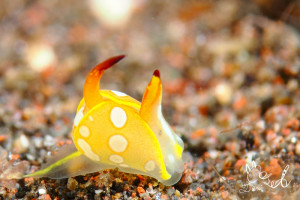
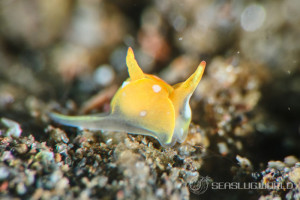
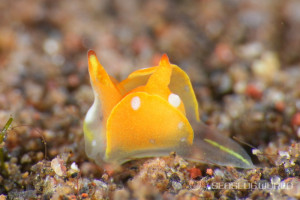
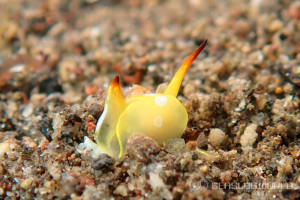
Siphopteron flavolineatum Ong & Gosliner, 2017
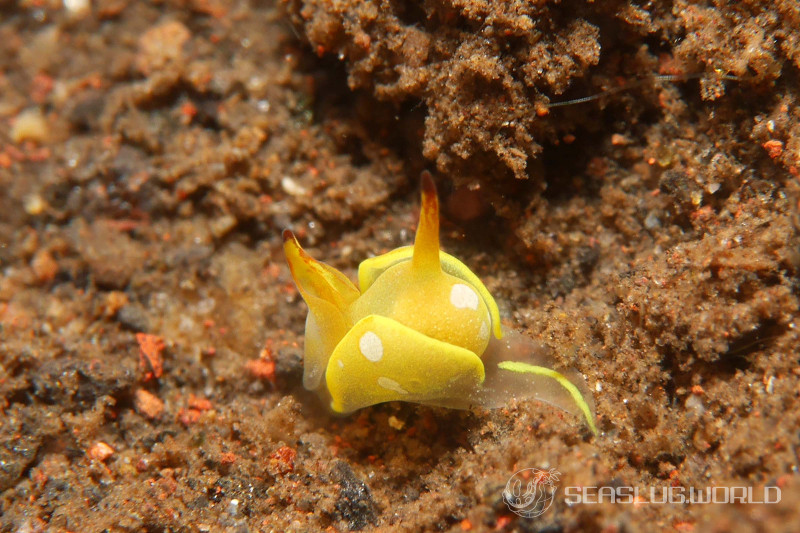
- Location
- Petti San, Tulamben, Pulau Bali, Indonesia
- Date
- 2019/04/16
- Length
- 3mm
- Depth
- 8.0m
- Water temperature
- 28.0℃
Description
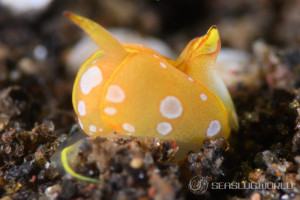
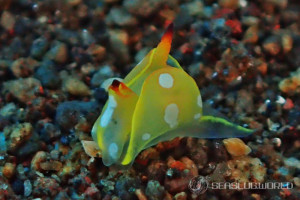
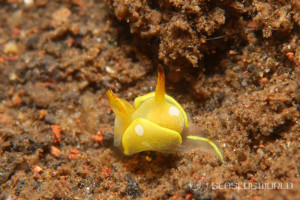
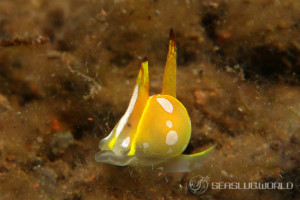
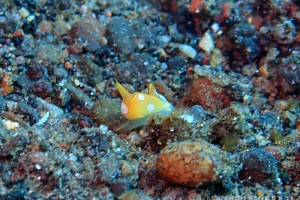
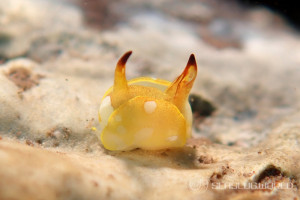
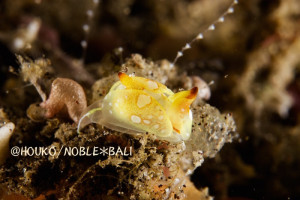
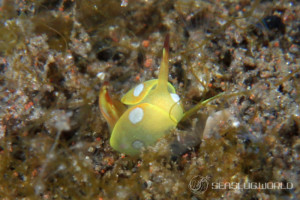
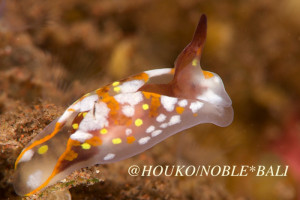
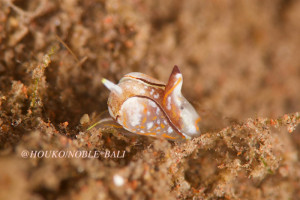
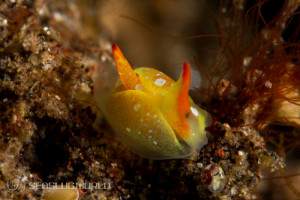
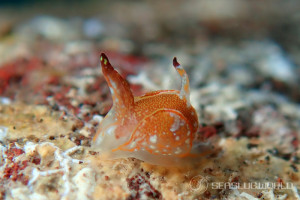
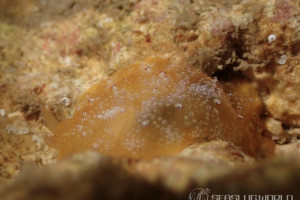
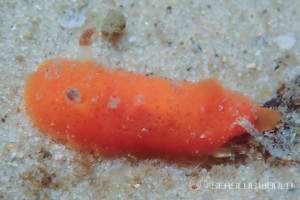
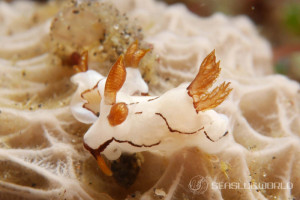
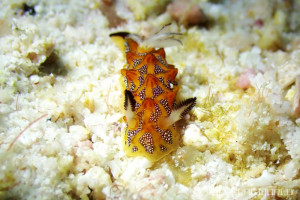
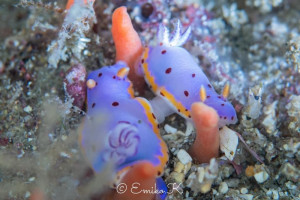
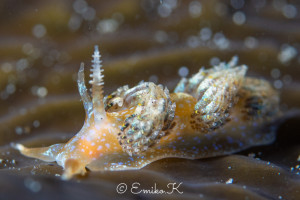
A small siphopteran 5–7 mm in length. Parapodia and foot ground colour clear to translucent white to ochre. Parapodia lined with yellow and vermillion accents. White spots dotting parapodia, head shield and visceral hump. Visceral hump more opaque than its appendages, vermillion with white spots. Visceral hump ochre to vermillion towards flagellum with white spots.Flagellum opaque ochre with vermillion outlined by yellow stripes at the end with black tip. Foot translucent white, lined with orange edges and central yellow stripe down middle. Flagellum centred on midline of visceral hump. Head shield roughly triangular in shape, broadest anteriorly and narrowing posteriorly into siphon. Siphon with central white stripe that bisects vertically on anterior side. Siphon with two symmetrical white dots on either side of head shield on a translucent ground colour transitioning posteriorly into ochre colour on siphon. Yellow stripe present on posterior side of siphon, lined with darker vermillion on either side. Siphon with prominent medial crest on posterior side, extending slightly above level of lateral margins. Gill small with three primary folds.
Shell: No trace of shell found in only specimen dissected. Radular formula 16 × (4·1·0·1·4) in one specimen (CASIZ 199132). Inner lateral teeth broad with single primary cusp. Masticatory margin of inner laterals broad with two large, well-separated triangular denticles. The penis is complex with elongate, highly convoluted prostate. Penial sac straight, containing c. 14 large, interiorly directed, acutely pointed cuticular spines (ps1). More posteriorly, at base of penial sac, are about 13 bifid, slightly smaller spines (ps2). Another series of 13 small spines found on the right side of anterior portion of penial sac (ps3) along with another anteromedial row of 13 spines (ps4). Secondary papilla found at the anterior end of penial sac and appearing to have acutely pointed cuticular spine.
Distribution
Type locality: Cemetery Beach, Tingloy, Batangas, Luzon, Philippines. Thus far, known only from the Philippines and Malaysia.Etymology
Verbatim from the original description (Ong et al., 2017, p.772):The species epithet, flavolineatum, refers to the yellow medial line on the posterior end of the foot, which distinguishes this species.
Remarks
Originally described as Siphopteron flavolineatum Ong & Gosliner, 2017. This species corresponds to specimens previously figured as Siphopteron sp. 6 (Gosliner, Valdés & Behrens, 2015).The colour pattern of S. flavolineatum, with an ochre colour with prominent white spots, is unique to this species. Morphologically, this species is similar to Siphopteron quadrispinosum Gosliner, 1989, which has an inner lateral radular tooth with two large quadrangular cusps. S. quadrispinosum differs in its colour pattern with a yellow body with red pigment on the apex of the siphon and on the flagellum, and in having a white margin along the edge of the parapodia. Internally, the penis is very different between the two species. The penis of S. quadrispinosum has four large basal cuticular spines with no smaller spines. There are small spines on the penial papilla. The secondary papilla has a massive cuticular spine that is used for hypodermic insemination. In contrast, S. flavolineatum has four distinct areas of spines, each with numerous spines. Phylogenetically, S. flavolineatum is sister to S. nakakatuwa, and both are found sympatrically in the Philippines. The two differ in their COI gene sequences by 8.8 %.
References
- Siphopteron sp. 6, Terrence Gosliner, Ángel Valdés and David Behrens. (2015). Nudibranch and Sea Slug Identification Indo-Pacific. New World Pubns Inc.
- Siphopteron flavolineatum sp. nov., Ong E., Hallas J.M. & Gosliner T.M. (2017). Like a bat out of heaven: the phylogeny and diversity of the bat-winged slugs (Heterobranchia: Gastropteridae). Zoological Journal of the Linnean Society. 180(4): 755-789. https://doi.org/10.1093/zoolinnean/zlw018
Featured in this book
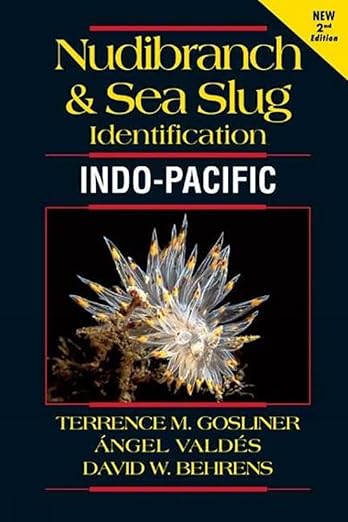
Terrence Gosliner, Ángel Valdés and David Behrens. (2018). Nudibranch and Sea Slug Identification Indo-Pacific 2nd Edition. New World Pubns Inc.
New World Publications
This species, Siphopteron flavolineatum, is included in the book.
View on Amazon PR (Amazon Associates)Seasonality
Shooting Locations
Loading shooting locations...
Photos of Siphopteron flavolineatum





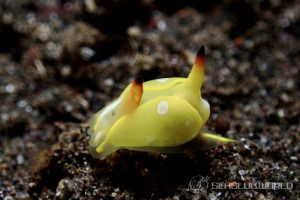

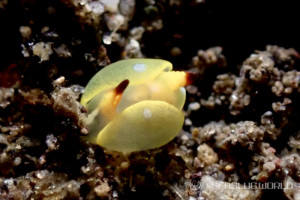
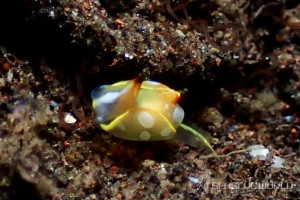
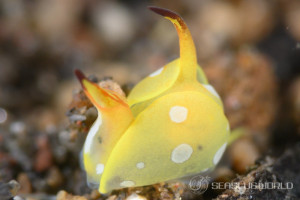






Same Genus Nudibranchs
Similar Colors Nudibranchs

Academic Database
Sea slug observation data is available in international marine biodiversity databases.