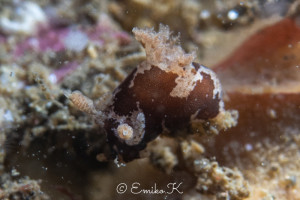
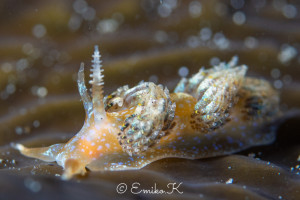
Trapania squama Gosliner & Fahey, 2008
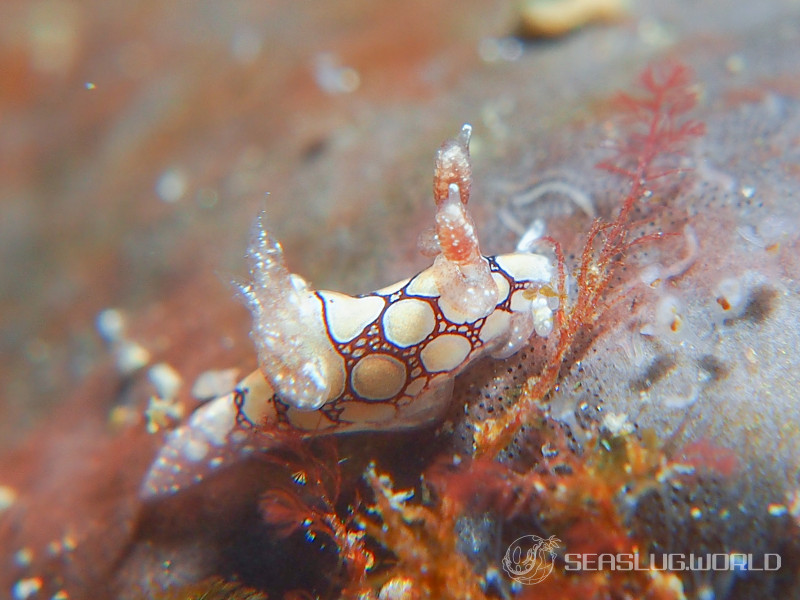
- Location
- Kamagane, Tago, Futou, Dougashima, Shizuoka, Japan
- Date
- 2018/12/04
- Length
- 5mm
- Depth
- 20.0m
- Water temperature
- 20.0℃
Description
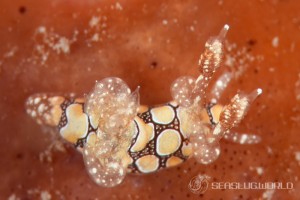
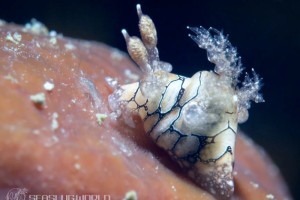
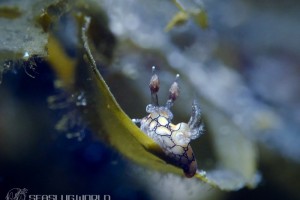
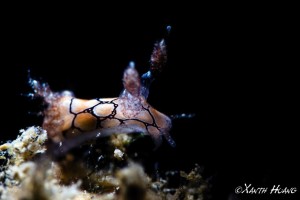
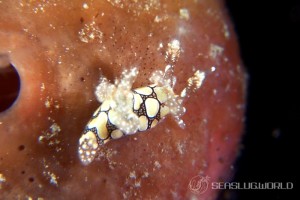
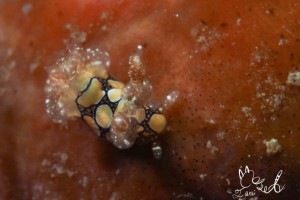
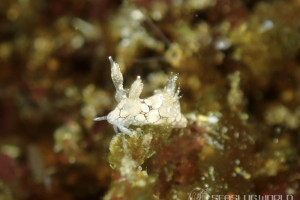
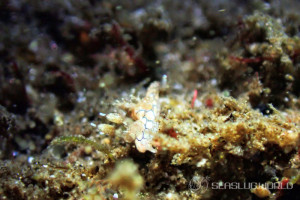
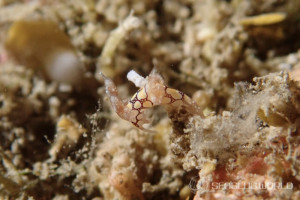
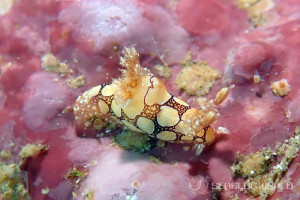
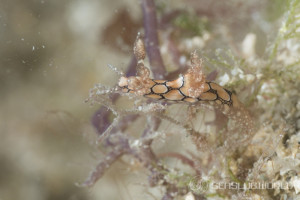
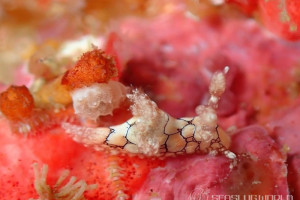
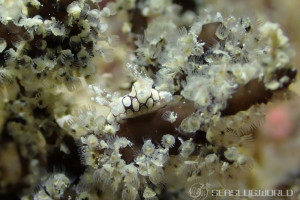
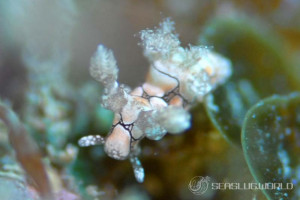
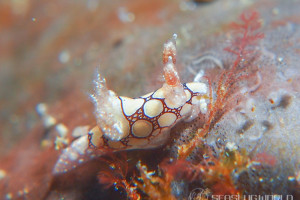
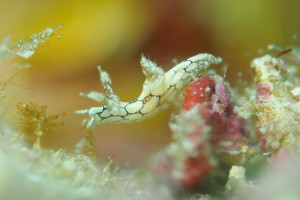
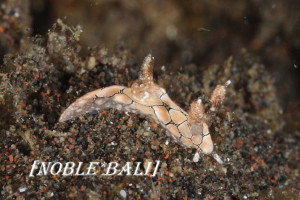
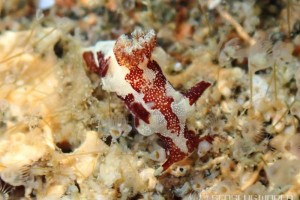
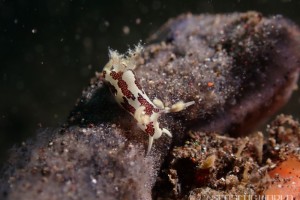
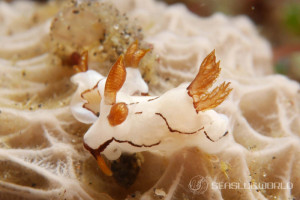
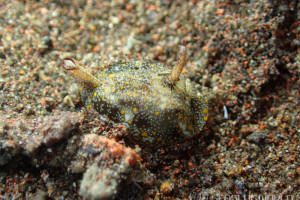
Body 4–11 mm long, elongate and convex, lacking a distinct notal margin. Widest at the branchial region. Oral tentacles are relatively long, cylindrical with rounded apices. Rhinophores have 6–9 lamellae, are bulbous and bear elongate tips. Extra-rhinophoral and extra-branchial appendages are thin and curved. The gill comprises three bipinnate branches.The body is creamy orange with mid-dorsal brown pigment, overlain by black lines forming a distinct scale-like pattern outlined in white. Brown streaks scatter on the head and behind the rhinophores; the posterior foot bears a brown reticulate pattern. Oral tentacles are orange basally with a brown blotchy apex. Extra-rhinophoral and extra-branchial appendages are muddy brown, as are the rhinophores and gill leaves; the latter bear random white blotches. Rhinophores have a white elongate tip.
Distribution
Papua New Guinea (type locality: Cement Mixer Reef, Madang) and the Marshall Islands (Enewetak Atoll).Etymology
Verbatim from the original description (Gosliner & Fahey, 2008, p.58):The specific name squama is taken from the Latin word meaning 'scale' to describe the distinct scale-like colour pattern of the notum.
Remarks
Described as one of 16 new Indo-Pacific Trapania species in Gosliner, T.M. & Fahey, S.J. 2008 Zoological Journal of the Linnean Society 152: 53-111. The authors stated: "Externally, this species does not closely resemble any other Trapania. No other species has the scale-like black markings on the dorsum. Only T. squama sp. nov., T. toddi Rudman, 1987 from the Red Sea and Hong Kong and T. reticulata Rudman, 1987 from the Great Barrier Reef, Australia have a brown reticulate pattern on the body. In T. squama, the reticulate pattern is coarse over most of the body while the fine reticulations similar to those of T. toddi and T. reticulata are confined to the posterior end of the foot" (p.59). Trapania sp. 3 Rudman (SeaSlug Forum) is referred here as a synonym (p.58).References
- Trapania squama sp. nov., Gosliner T.M. & Fahey S.J. (2008). Systematics of Trapania (Mollusca: Nudibranchia: Goniodorididae) with descriptions of 16 new species. Systematics and Biodiversity. 6(1): 53-98. https://doi.org/10.1017/s1477200007002587
- Trapania squama, Terrence Gosliner, Ángel Valdés and David Behrens. (2015). Nudibranch and Sea Slug Identification Indo-Pacific. New World Pubns Inc.
- ウロコツガルウミウシ(新称), 中野理枝 & 小谷光. (2016). 高知県大月町樫西海域及び一切海域から記録された後鰓類. Kuroshio Biosphere. 12: 21-43.
- ウロコツガルウミウシ, 中野理枝. (2018). 日本のウミウシ. 文一総合出版.
Featured in this book

Terrence Gosliner, Ángel Valdés and David Behrens. (2018). Nudibranch and Sea Slug Identification Indo-Pacific 2nd Edition. New World Pubns Inc.
New World Publications
This species, Trapania squama, is included in the book.
View on Amazon PR (Amazon Associates)Seasonality
Shooting Locations
Loading shooting locations...
Photos of Trapania squama
















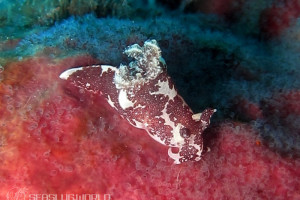
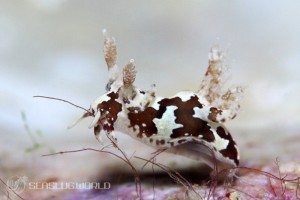
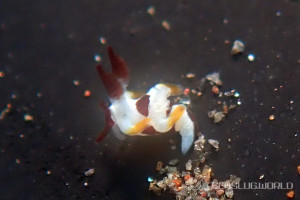
Same Genus Nudibranchs
Similar Colors Nudibranchs

Academic Database
Sea slug observation data is available in international marine biodiversity databases.