Ilbia mariana Hoff & Carlson, 1990
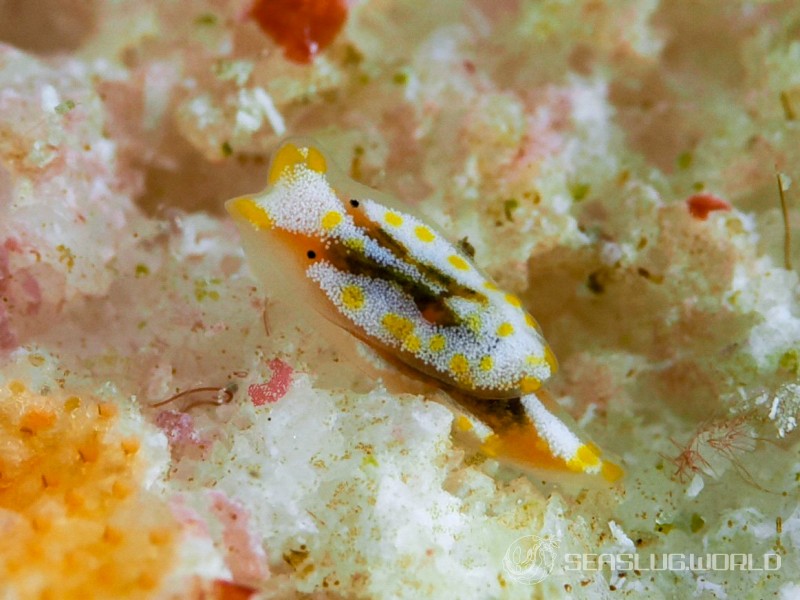
- Location
- Surgeon Reef, Miyakojima, Okinawa, Japan
- Date
- 2024/08/14
- Length
- 3mm
- Depth
- 12.0m
- Water temperature
- 28.0℃
Description
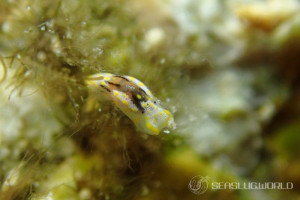
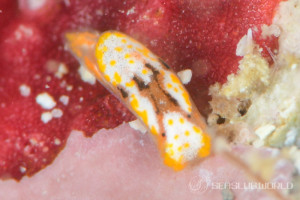
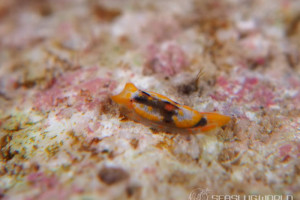
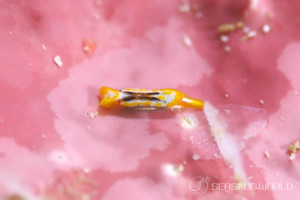
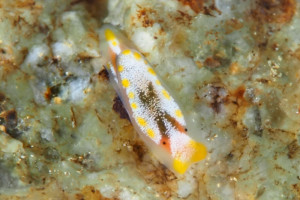
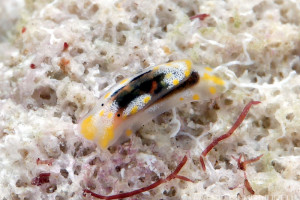
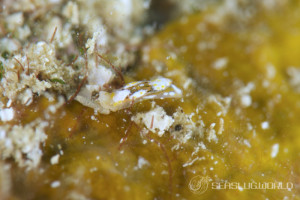
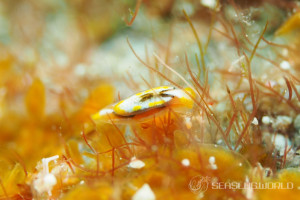
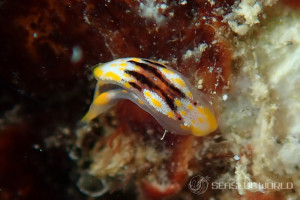
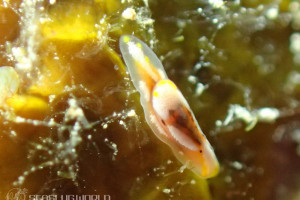
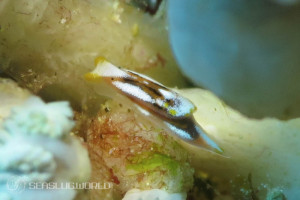
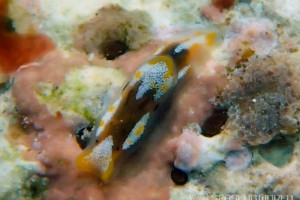
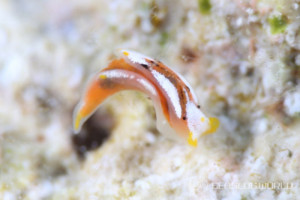
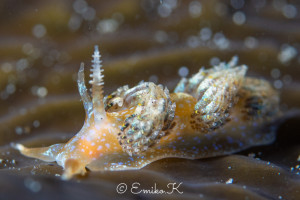
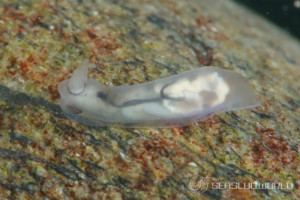
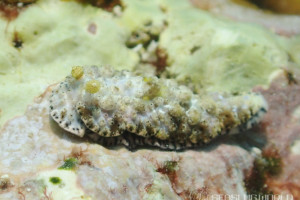
A small runcinid, 1.6 to 4.3 mm in length, with a smooth, elongate dorsum and lacking parapodia, gills, shell, and gizzard plates. The dorsum is widest at the head and middorsum, slightly concave anteriorly and rounded posteriorly, with a bluntly pointed tail. The widely set eyes lie at the narrowest part of the dorsum and are clearly visible from above. The anus opens beneath the fold between the mantle edge and the tail, slightly right of the midline.Two color forms are known. In the common form the body is cream to yellow with a middorsal dark area produced by the brown digestive gland showing through an unpigmented patch of dorsum; underlying white granules cover much of the dorsum, parts of the tail, and the sides of the foot, and translucent yellow spots in the epidermis give a yellow cast where they fuse. Four ovate brown spots mark the corners of the middorsal dark area, and the eye spots are black. A variant form, found only at one locality on Guam (four specimens), has large solid dark brown areas middorsally, on the tail, and along the dorsal margin outside the eyes; white areas anterior and posterior to the middorsal patch and along the midline of the tail; and bright red-orange or yellow on the sides of the head, beside the middorsal dark area, and along the posterior midline of the tail.
Distribution
Mariana Islands (Guam, Rota, Tinian, Saipan, Pagan, Maug). The type locality is the Mariana Islands; the holotype is deposited at the Bishop Museum, Honolulu (BPBM 209629). The species occurs on both windward and leeward shores down to a depth of 14 m, and is most common between the reef flat and 4 m. Animals are found openly crawling on algae, but no specific algal host has been identified.Etymology
Named for the Mariana Islands, where the species was discovered.Remarks
Over 700 specimens have been recorded from the Mariana chain since 1969, but the species has not yet been found south of Guam despite extensive collecting elsewhere in Micronesia. The co-occurring runcinid Metaruncina setoensis often forms large aggregations in the same area, whereas I. mariana is rarely encountered in groups of more than two or three individuals.References
Featured in this book

中野理枝. (2019). 日本のウミウシ. 第二版. 文一総合出版.
文一総合出版
This species, Ilbia mariana, is included in the book.
View on Amazon PR (Amazon Associates)Seasonality
Shooting Locations
Loading shooting locations...
Photos of Ilbia mariana












Same Genus Nudibranchs
Similar Colors Nudibranchs

Academic Database
Sea slug observation data is available in international marine biodiversity databases.