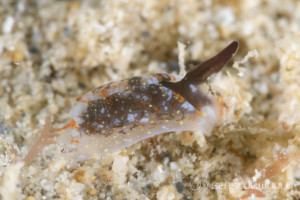
Metaruncina setoensis (Baba, 1954)
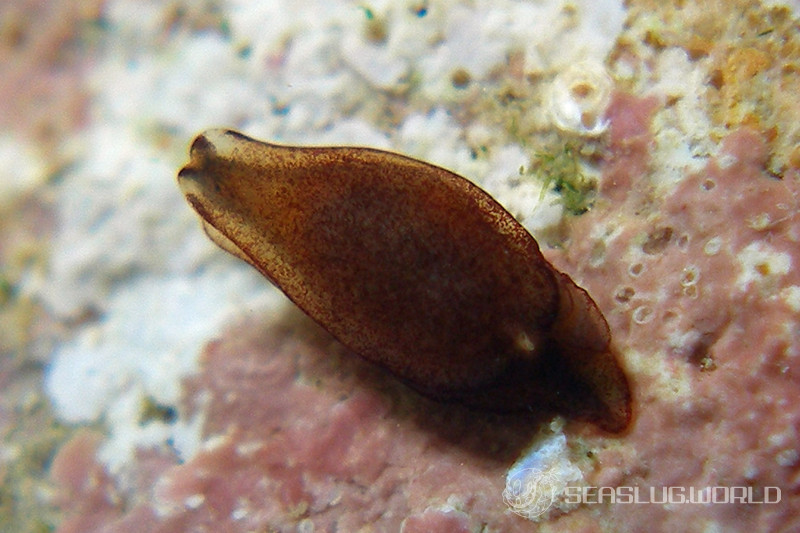
- Location
- Red Beach, Okinawa Island (East coast), Okinawa, Japan
- Date
- 2008/04/25
- Length
- 3mm
- Depth
- 3.0m
- Water temperature
- 22.0℃
Description
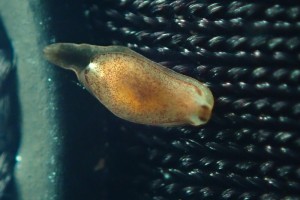
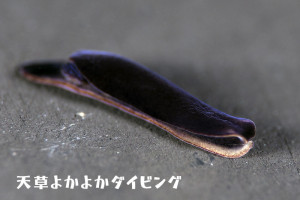
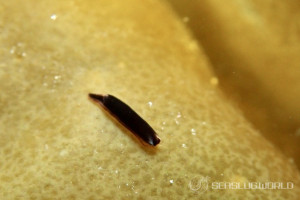
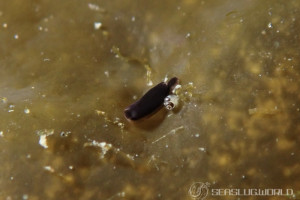
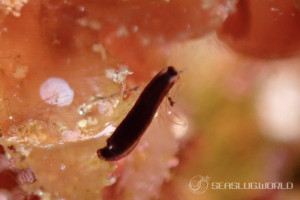
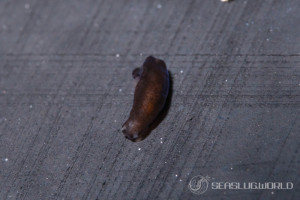
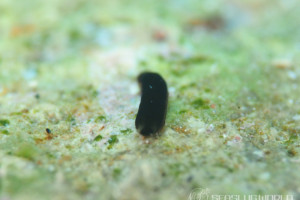
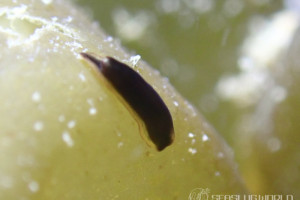
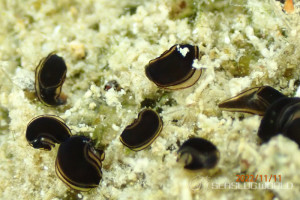
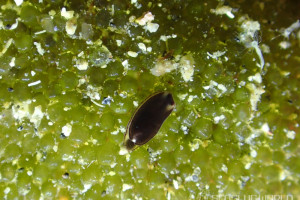
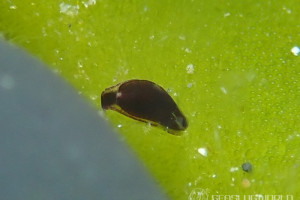
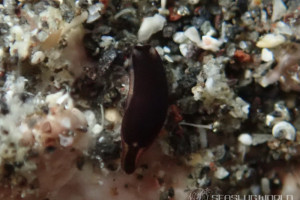
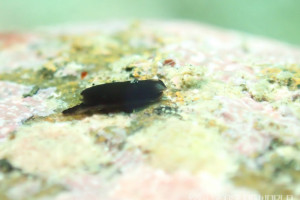
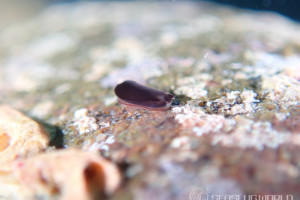
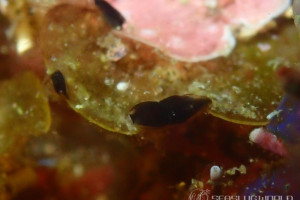
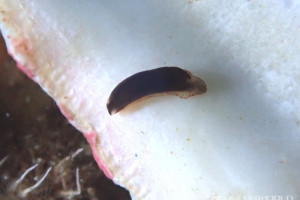
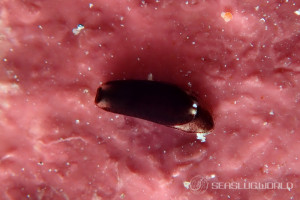
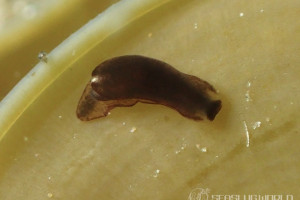
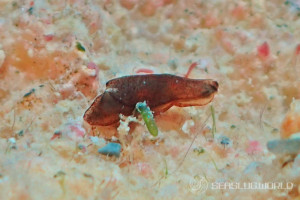
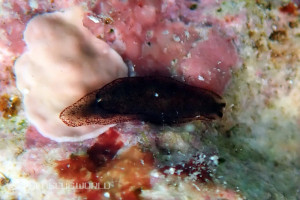
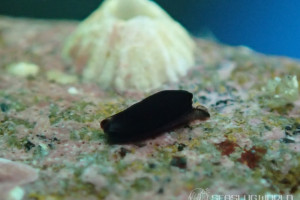
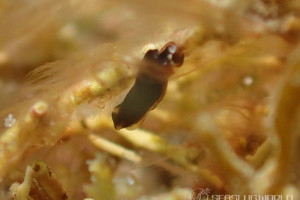
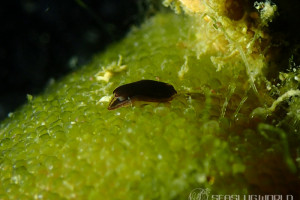
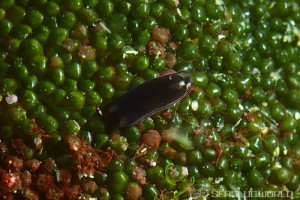
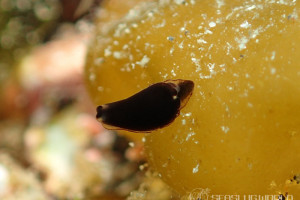
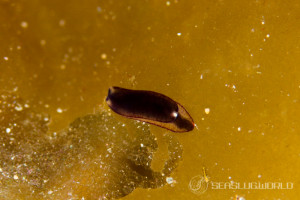
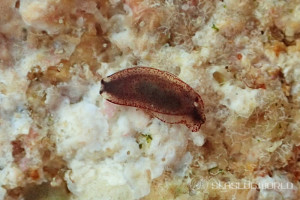
A small limaciform sea slug, 3-7 mm in body length in the original description (Baba, 1954) and about 6 mm from head to tail-tip in mature specimens redescribed by Baba 1967. Dorsum entirely smooth, covered by a broad mantle. Oral tentacles absent. The head is shallowly bilobed in front, with paired sessile eyes shining through the skin. The foot projects slightly behind the mantle. The anus is median, just behind the posterior end of the mantle, and a single gill of about 4-6 alternating pinnae lies on the right side of the body, immediately behind the anus. General colour blackish, darker along the middle of the back, with the entire dorsum sprinkled with minute brown spots. A submarginal band of ashy yellow runs around the mantle except across the front of the head. The sole is dirty yellowish, dusted with minute brown spots; the gill is also blackish. The shell is wholly internal, located in the posterior part of the mantle, whitish, much reduced and flattened-haliotiform, only 0.2-0.4 mm long. Paired jaw-plates bear a dense covering of rod-like denticles. The radula is strongly degenerate and difficult to formulate. The gizzard contains four chitinous plates, each with a series of 11-12 acutely pointed laminae.Distribution
Type locality: Seto, Kii, Middle Japan (the shore around the Seto Marine Biological Laboratory, Wakayama). The original description was based on only 12 specimens collected from beneath pebbles in high-level tide pools in January and March 1951 and January and April 1953 by Iwao Hamatani and Kikutaro Baba. Baba 1967 reported a great population increase at the type locality between 1955 and 1959, which provided material for studies of spawn and direct development. The species has been recorded across the Indian Ocean and the western and central Pacific, with reports from South Africa, Japan and the Marshall Islands.Etymology
The specific epithet setoensis is a Latin toponymic adjective referring to the type locality, Seto in Kii Province (i.e. the shore at the Seto Marine Biological Laboratory, Shirahama, Wakayama Prefecture).Remarks
Originally described as the second Japanese species of Runcina, the species was made the type of a new genus, Metaruncina, by Baba 1967. The genus name combines the prefix meta- (meaning "near", "after" or "transformed") with the existing genus name Runcina, conveying "a genus close to Runcina". Baba 1967 regarded Metaruncina as most closely allied to Ildica Bergh, 1889 from Mauritius, sharing the unusual cephalaspidean condition of a single gill on the right posterior side of the body, but distinguished it by a strongly degenerate radula not arranged in distinct rows (vs. a triseriate 1.1.1 radula in Ildica), an entirely internal shell (vs. an externally exposed shell in Ildica), and female genitalia lacking a spermatheca (bursa copulatrix).References
- Runcina setoensis BABA n. sp. Kurohime-umiushi (new name), Baba K. (1954). RUNCINA SETOENSIS, A NEW AND RARE SPECIES FROM THE COAST OF KII, MIDDLE JAPAN (OPISTHOBRANCHIA). Publications of the Seto Marine Biological Laboratory. 3(3): 373-374. https://doi.org/10.5134/174484
- Metaruncina setoensis (Baba, 1954), Chernyshev A.V. (2021). A new species of Metaruncina (Gastropoda: Heterobranchia: Runcinida) from Vietnam with a discussion on the so-called rudimentary radula in runcinids. Zootaxa. 4974(1): 197-200.
A Kindle field guide by the site author
Kimoto N. (2026). Sea Slugs of Japan & the Indo-Pacific, 2nd Edition.
Kindle Edition
View on Amazon PR (Amazon Associates)Seasonality
Shooting Locations
Loading shooting locations...
Photos of Metaruncina setoensis
























Similar Colors Nudibranchs


Academic Database
Sea slug observation data is available in international marine biodiversity databases.