Murphydoris adusta Paz-Sedano, Smirnoff, Candás, Gosliner & Pola, 2022
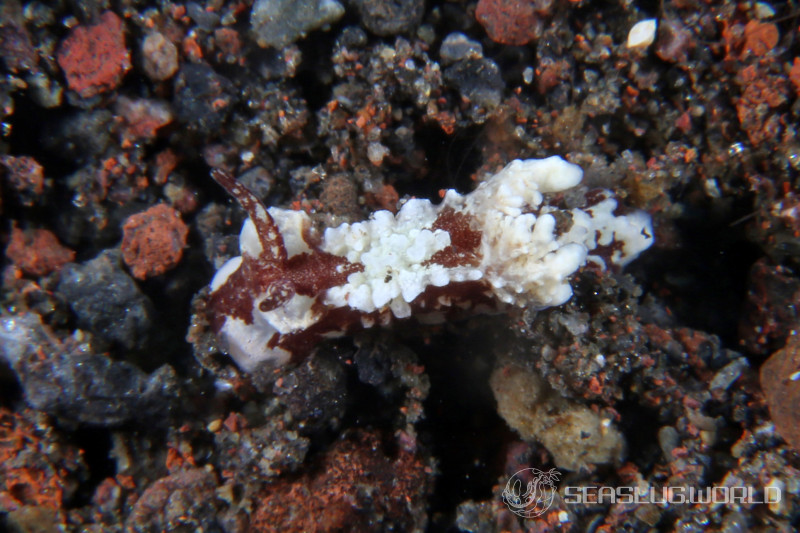
- Location
- Seraya, Tulamben, Pulau Bali, Indonesia
- Date
- 2015/11/14
- Length
- 5mm
- Depth
- 20.0m
- Water temperature
- 29.0℃
Description
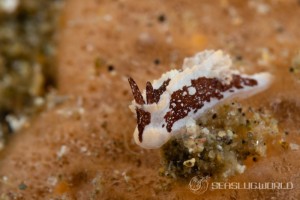
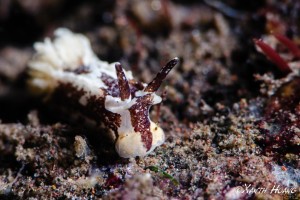
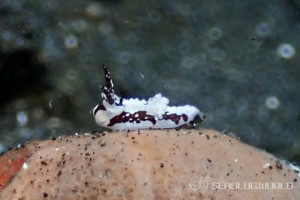
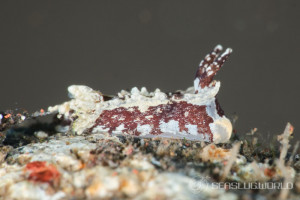
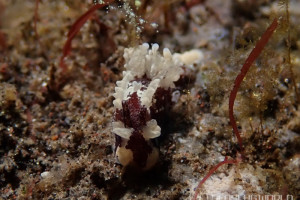
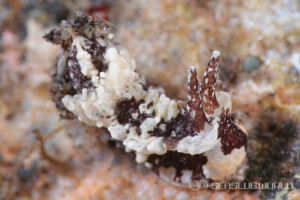
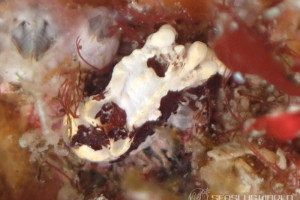
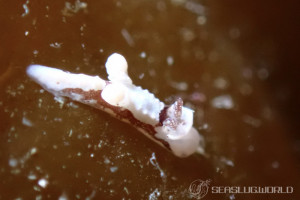
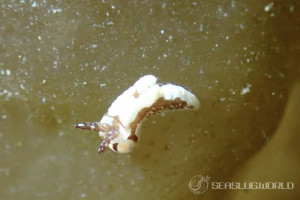
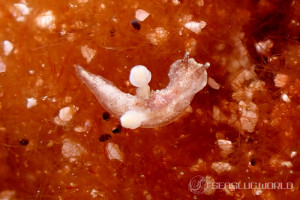
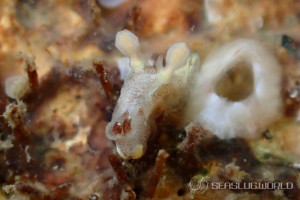
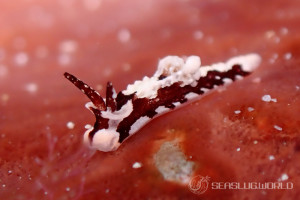
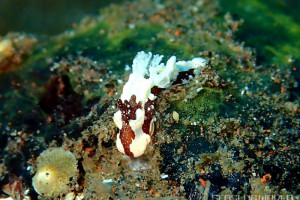
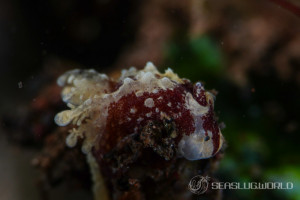
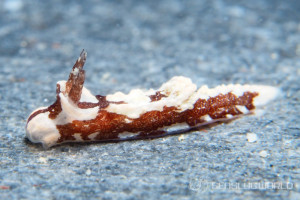
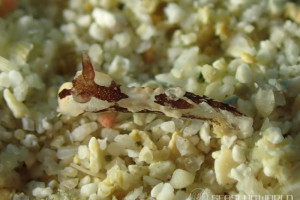
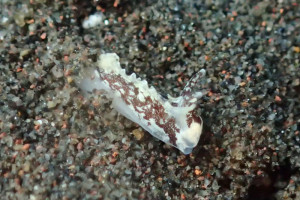
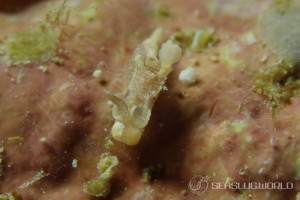
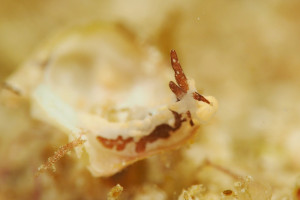
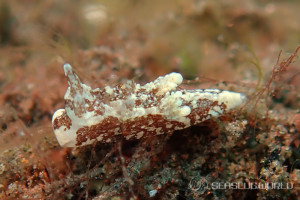
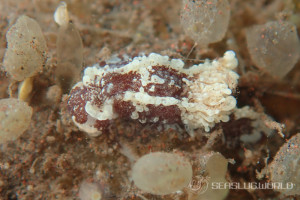
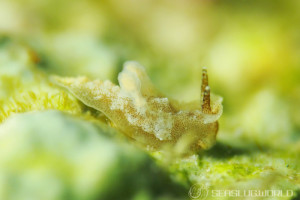
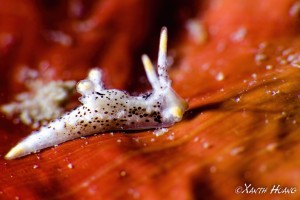
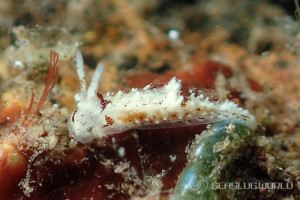
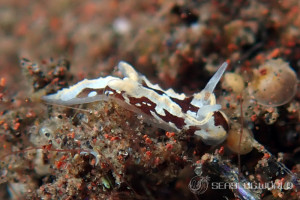
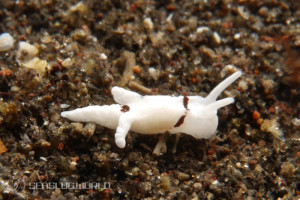
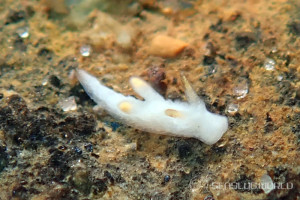
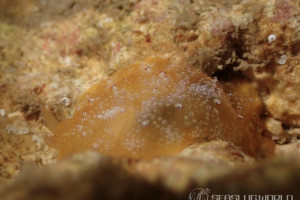
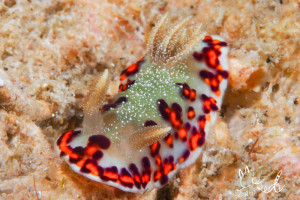
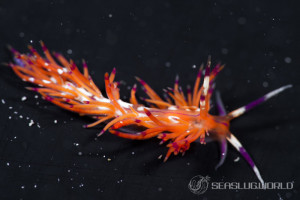
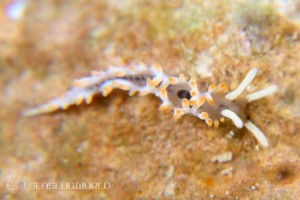
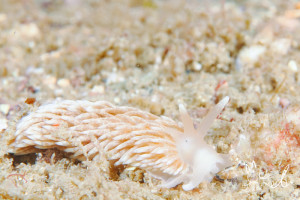
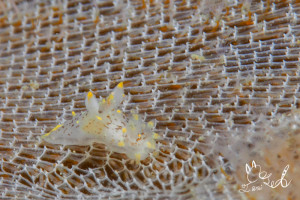
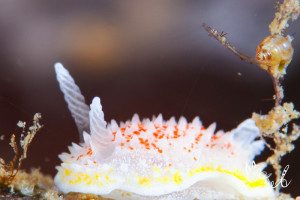
A tiny goniodoridid 2–3 mm in preserved length. The body is elongate, slender and limaciform; the foot is tapered posteriorly with a slightly rounded edge at the anterior end and does not protrude beyond the sides of the notum.The body is chocolate brown with patches of pale blue and iridescent white. The edge of the notum is the same colour as the body, with discontinuous pale-yellow coloration at its border. The middle of the dorsum bears a transverse iridescent white line flanked by a yellow patch on each side. The anteriormost part of the head is iridescent white with a chocolate brown band across the middle. The rhinophores share the body colour. The three bipinnate gill branches are translucent white with yellow tips, the central larger branch sometimes more strikingly tipped. A thin line of iridescent white runs forward from the base of each gill branch and joins at the beginning of the tail, continuing as a broad iridescent white dorsal band to the tail tip. Yellowish pigmentation may also be present. The foot is bluish with small brown spots.
Distribution
Widely distributed in the Indian Ocean and the western Pacific. Type locality: La Balsa Park, Mooloolah River, Queensland, Australia, 3–6 m depth. Other records include Madagascar, Indonesia (Bali, Palau Sangeang), the Philippines (Batangas, Negros Oriental), Taiwan (Penghu), Japan (Izu Peninsula), and Australia (New South Wales, Queensland). The species is found from about 1 m down to 21 m, on red algae or under coral rubble.Etymology
The specific epithet adusta is the Latin feminine of adustus (perfect passive participle of aduro, "to burn"), meaning "scorched" or "dark-brown", in reference to the dark chocolate-brown body colour.Remarks
Unusually among Goniodorididae, this species feeds on compound (colonial) tunicates. Most other members of the family — including the other species of Murphydoris — feed on bryozoans or entoprocts, so this dietary specialisation serves as an additional diagnostic for M. adusta.References
- Goniodoris aspersa, Helmut Debelius, Rudie H. Kuiter. (2007). Nudibranchs of the World.
- Goniodoridella sp. 6, Terrence Gosliner, Ángel Valdés and David Behrens. (2015). Nudibranch and Sea Slug Identification Indo-Pacific. New World Pubns Inc.
- Goniodoridella sp. 4, 中野理枝. (2018). 日本のウミウシ. 文一総合出版.
- Goniodoridella sp. 6, Terrence Gosliner, Ángel Valdés and David Behrens. (2018). Nudibranch and Sea Slug Identification Indo-Pacific 2nd Edition. New World Pubns Inc.
- カイヒメウミウシ, 小野篤司 & 加藤昌一. (2020). 新版 ウミウシ. 誠文堂新光社.
- Murphydoris adusta sp. nov., Paz-Sedano, S., Smirnoff, D., Candás, M., Gosliner, T.M. & Pola, M. (2022). Rediscovering the overlooked genus Murphydoris (Nudibranchia: Goniodorididae): the first phylogeny and addition of four new species. Zoological Journal of the Linnean Society. DOI: 10.1093/zoolinnean/zlab122., available online at https://doi.org/10.1093/zoolinnean/zlab122
- Murphydoris adusta (Clade E), Paz-Sedano S., Moles J., Smirnoff D., Gosliner T.M. & Pola M. (2024). A combined phylogenetic strategy illuminates the evolution of Goniodorididae nudibranchs (Mollusca, Gastropoda, Heterobranchia). Molecular Phylogenetics and Evolution. 192: 107990. https://doi.org/10.1016/j.ympev.2023.107990
Featured in this book
Terrence Gosliner, Ángel Valdés and David Behrens. (2018). Nudibranch and Sea Slug Identification Indo-Pacific 2nd Edition. New World Pubns Inc.
New World Publications
This species, Murphydoris adusta, is included in the book.
View on Amazon PR (Amazon Associates)Seasonality
Shooting Locations
Loading shooting locations...
Photos of Murphydoris adusta


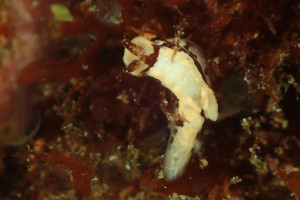

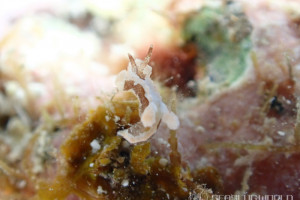

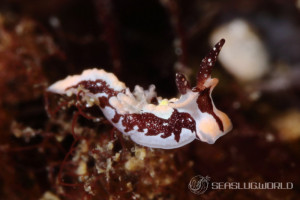

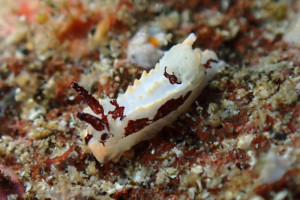












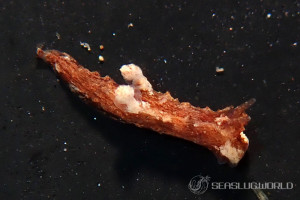

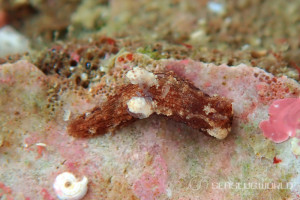
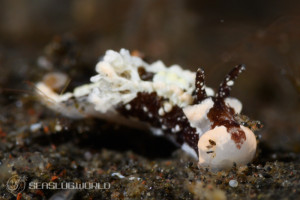

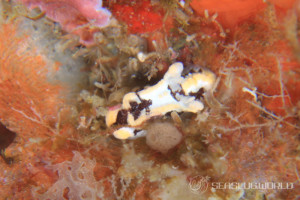


Same Genus Nudibranchs
Similar Colors Nudibranchs

Academic Database
Sea slug observation data is available in international marine biodiversity databases.