Coryphellina exoptata (Gosliner & Willan, 1991)
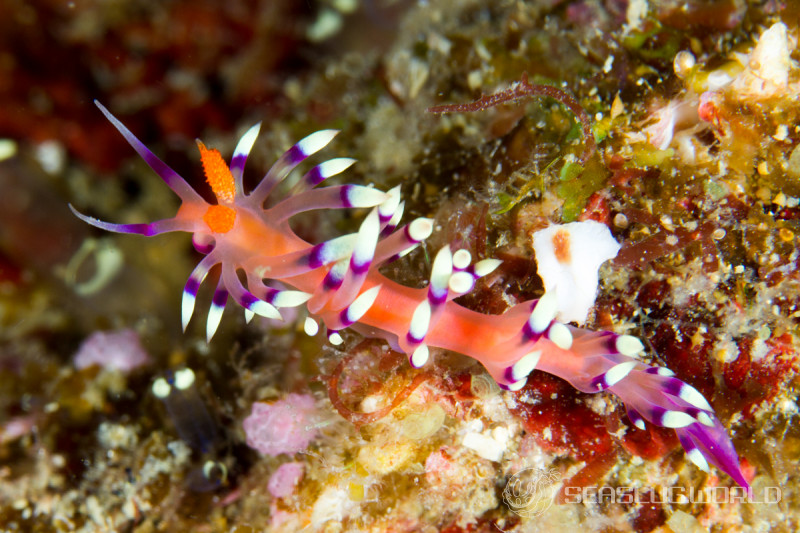
- Location
- Gato Island, Malapascua, Philippines
- Date
- 2017/10/03
- Length
- 20mm
- Depth
- 12.0m
- Water temperature
- 30.0℃
Description
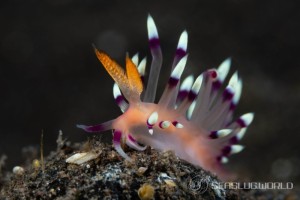
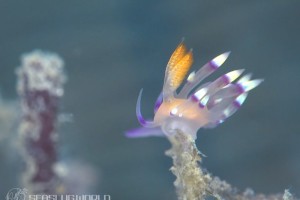
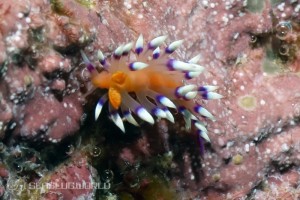
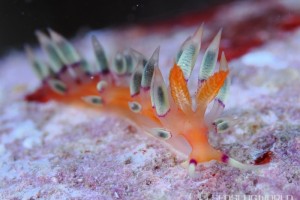
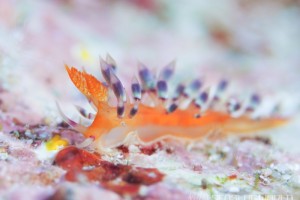
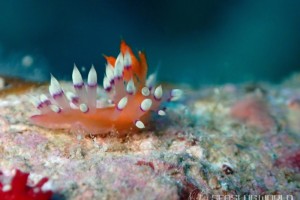
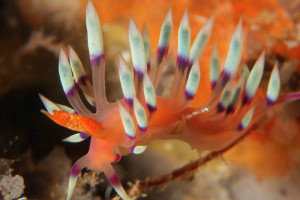
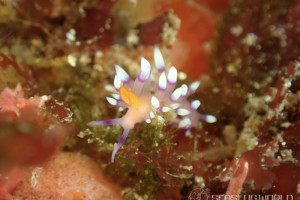
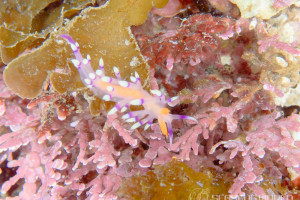
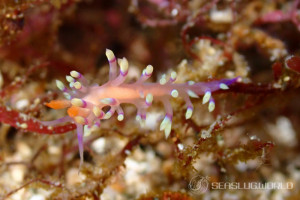
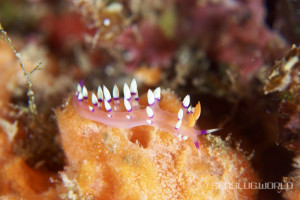
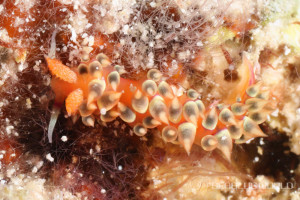
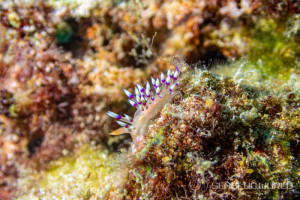
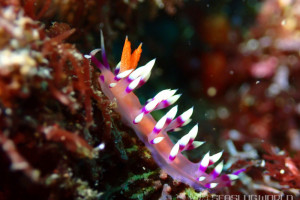
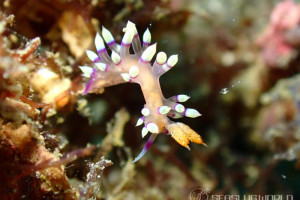
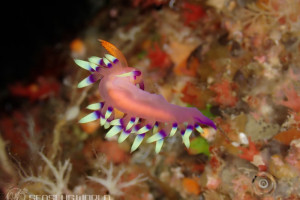
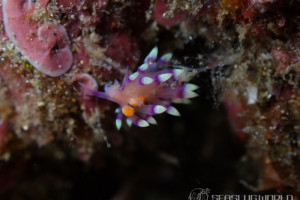
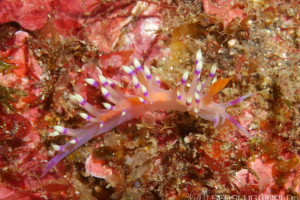
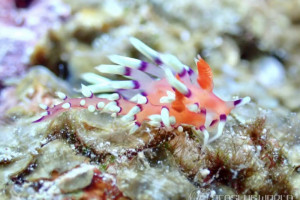
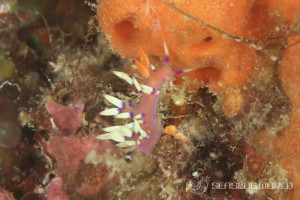
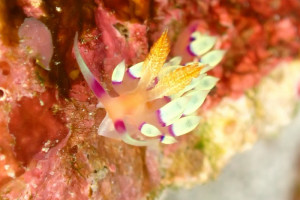
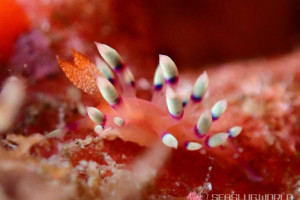
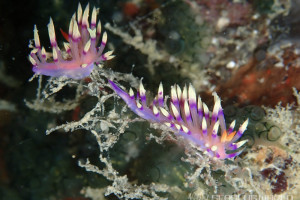
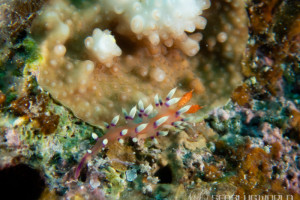
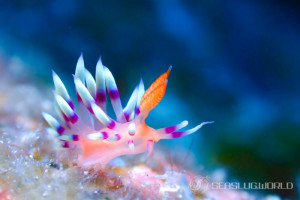
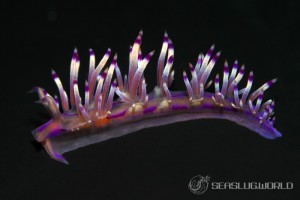
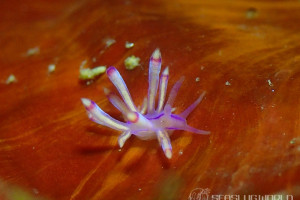
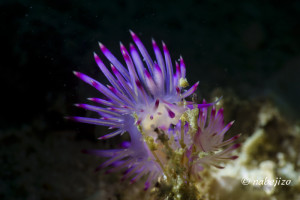
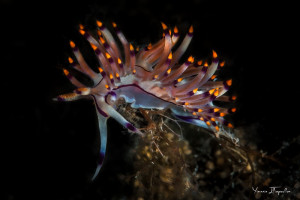
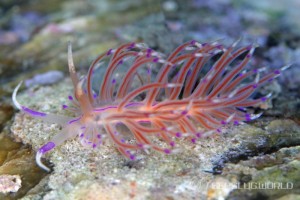
A flabellinid reaching about 30 mm in length. The general body color is deep pinkish purple and the cerata bear a striking combination of purple and yellowish-white bands, making this one of the most beautifully colored members of the genus.Basally, the oral tentacles are the same color as the rest of the body and the outer third is generally opaque cream yellow. However, in some specimens from Aldabra Atoll, there is no opaque pigment on the outer portion of the tentacles and they are the same color as the rest of the body. Purple pigment is also present on the apical portion of the foot corners. The rhinophores are vivid orange with yellow pigment on the apices of the rhinophoral papillae.
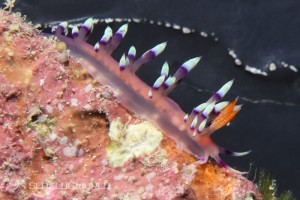
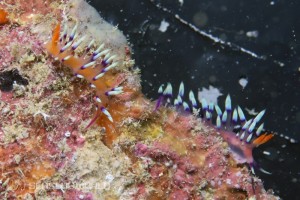
The basal half to two-thirds of the cerata is pinkish purple. Above this section, a deep purple ring is present, and the apical portion of the cerata is opaque cream yellow. The cerata are thick and cylindrical for most of their length but taper to a distinctly pointed apex. The cerata are slightly elevated from the notum on a common peduncle.
The body is stockier than other members of the genus. The notal brim is expanded at the level of each ceratal group, but is otherwise reduced compared to Coryphellina rubrolineata. The oral tentacles are cylindrical throughout their length and they taper to an acute apex. The rhinophores are thick basally, and terminate in a distinctly pointed apex. The posterior side of each rhinophore bears over 120 densely packed, elongate papillae. The foot corners are elongate and tentacular, and are generally recurved posteriorly when the animal is actively crawling.
The cerata are arranged in distinct rows. The precardiac ceratal cluster consists of three distinct rows, with 1–3 cerata per row. The postcardiac cerata are arranged in 4 or 5 linear rows that are well separated from each other. The anterior postcardiac row contains the most cerata (3–5), the more posterior rows contain fewer cerata, and the posteriormost row consists of only a single ceras. The gonopore is situated ventral to the second and third ceratal rows on the right side of the body. The pleuroproctic anus is located below the notum within the interhepatic space. The nephroproct is immediately anterodorsal to the anus.
The muscular buccal mass occupies the anterior portion of the body, from the rhinophores to the anterior end of the head. The narrow ducts of the paired oral glands emanate from the anterior end of the buccal mass. These glands are highly ramified and extend posteriorly into the peduncle of the anteriormost ceratal cluster. The chitinous jaws are elongate and broad. The masticatory border bears several rows of elongate denticles; the denticles of the outermost row are longest. The radular formula is 23–37 × 1·1·1· in the two specimens examined. The rachidian teeth are narrow and elongate. The posterior limit of each limb bears a peduncle for attachment to the following tooth. The cutting edge bears 7–10 elongate denticles on either side of the elongate, acutely pointed central cusp. The central cusp is depressed below the level of the adjacent denticles. The lateral teeth are triangular with a broad base and an elongate, acutely pointed primary cusp. There are 13–20 minute, acutely pointed denticles along the inner margin of the tooth.
The preampullary duct is narrow and elongate. It expands into an elongate, curved ampulla. The ampulla narrows again and divides into the oviduct and vas deferens. The oviduct is narrow and elongate and expands to join the two large receptacula seminis (bilobed). The inner receptaculum is distinctly larger than the one closer to the female gland mass. A distinct bursa copulatrix is absent. A distinct vaginal duct continues from the oviduct to its own aperture, adjacent to the penis.
Distribution
Type locality: Planet Rock, 10 km S of Madang, Papua New Guinea, 24.4 m maximum depth. Known from Enewetak (Marshall Islands), Guam, Fiji, Queensland (Australia), Western Australia, Papua New Guinea, Malaysia and Aldabra Atoll, indicating a wide distribution throughout the Indo-Pacific tropics.Etymology
The specific epithet exoptata means "much desired" and refers to the strikingly beautiful color of this species.Remarks
Originally described as Flabellina exoptata Gosliner & Willan, 1991. The cladistic analysis of a 2017 revision transferred the species to Coryphellina, the currently valid name being Coryphellina exoptata.The unique color pattern readily distinguishes C. exoptata from three other described Flabellina-clade species with papillate rhinophores: Coryphellina rubrolineata, F. poenicia (Burn, 1957) and F. marcusorum Gosliner & Kuzirian, 1990. All three of these have the cerata of the postcardiac groups arranged in horseshoe-shaped arches, whereas those of C. exoptata are in simple, linear rows. In F. marcusorum the bursa copulatrix is large and obvious; in C. rubrolineata and C. delicata it is reduced; and in C. exoptata it is entirely absent.
In coloration, C. exoptata is most similar to F. marcusorum, but this species lacks the yellow pigment on the posterior surface of the rhinophoral papillae present in C. exoptata. In addition, F. marcusorum has opaque white pigment on the posterior end of the foot, which is not present in C. exoptata.
The species had previously been erroneously identified as Flabellina macassarana Bergh, 1905 on a Malaysian postage stamp. F. macassarana differs in several important aspects: it has perfoliate rather than papillate rhinophores, the shape and denticulation of the radular teeth differ markedly, and F. macassarana has only 20 rows of teeth in the radula, whereas C. exoptata has 23–37 rows.
References
- Flabellina exoptata Gosliner & Willan, sp. nov., Gosliner, T. M.; Willan, R. C. (1991). Review of the Flabellinidae (Nudibranchia: Aeolidacea) from the tropical Indo-Pacific, with the descriptions of five new species. The Veliger. 34(2): 97-133.
- アデヤカミノウミウシ, 小野篤司. (1999). ウミウシガイドブック. TBSブリタニカ.
- フラベリナ・エクソプタタ, 殿塚孝昌. (2003). ウミウシガイドブック〈3〉. TBSブリタニカ.
- アデヤカミノウミウシ, 小野篤司. (2004). 沖縄のウミウシ. ラトルズ.
- アデヤカミノウミウシ, 中野理枝. (2004). 本州のウミウシ. ラトルズ.
- Flabellina exoptata, Terrence Gosliner, Ángel Valdés and David Behrens. (2015). Nudibranch and Sea Slug Identification Indo-Pacific. New World Pubns Inc.
- Coryphellina exoptata (Gosliner & Willan, 1991), comb. n., Korshunova T., Martynov A., Bakken T., Evertsen J., Fletcher K., Mudianta I.W., Saito H., Lundin K., Schrödl M. & Picton B. (2017). Polyphyly of the traditional family Flabellinidae affects a major group of Nudibranchia: aeolidacean taxonomic reassessment with descriptions of several new families, genera, and species (Mollusca, Gastropoda). ZooKeys. 717: 1-139. https://doi.org/10.3897/zookeys.717.21885
Featured in this book

Terrence Gosliner, Ángel Valdés and David Behrens. (2018). Nudibranch and Sea Slug Identification Indo-Pacific 2nd Edition. New World Pubns Inc.
New World Publications
This species, Coryphellina exoptata, is included in the book.
View on Amazon PR (Amazon Associates)Seasonality
Shooting Locations
Loading shooting locations...
Photos of Coryphellina exoptata




















Same Genus Nudibranchs


Similar Colors Nudibranchs
Academic Database
Sea slug observation data is available in international marine biodiversity databases.