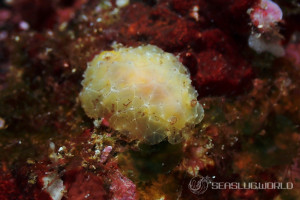
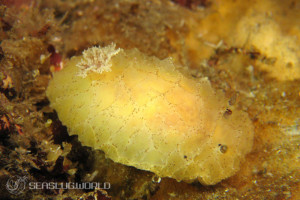
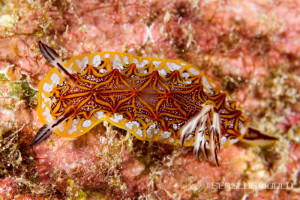
Halgerda dalanghita Fahey & Gosliner, 1999
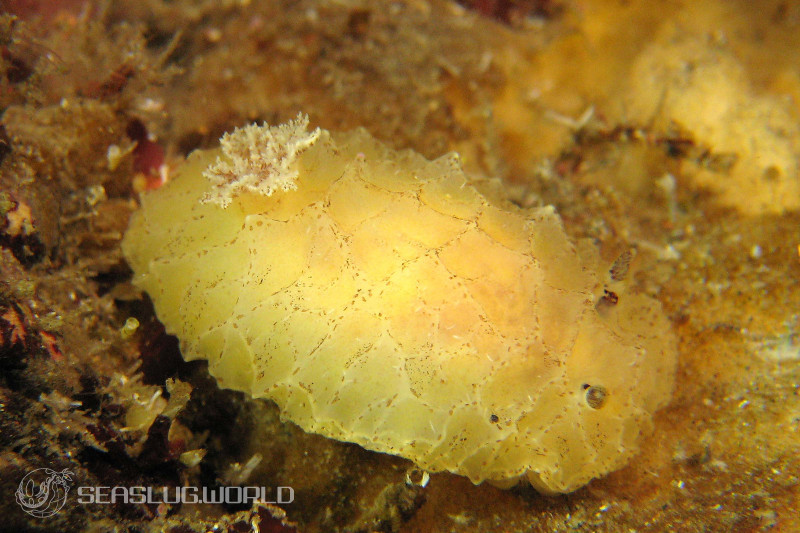
- Location
- Otchogahama, Hachijo Island, Tokyo, Japan
- Date
- 2008/01/19
- Length
- 30mm
- Depth
- 15.0m
- Water temperature
- 20.0℃
Description
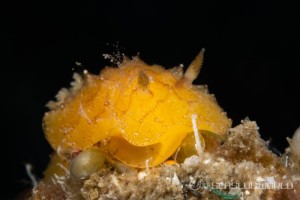
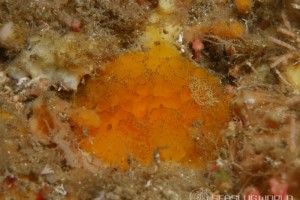
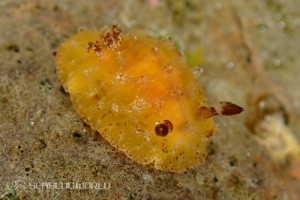
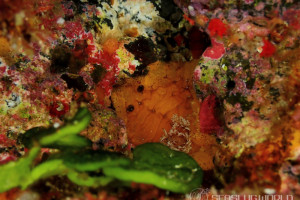
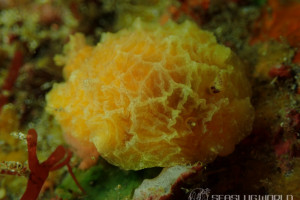
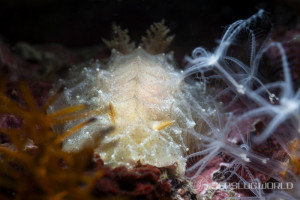
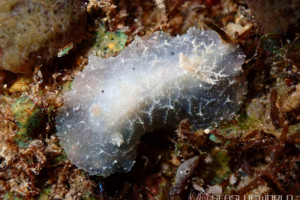
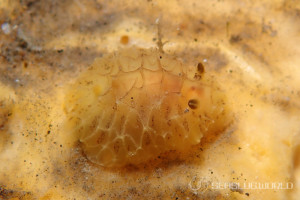
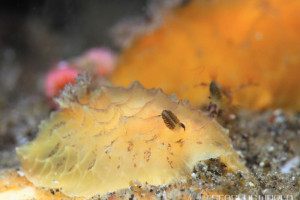
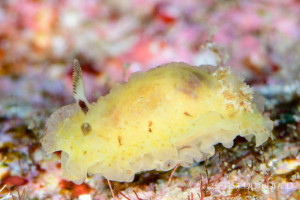
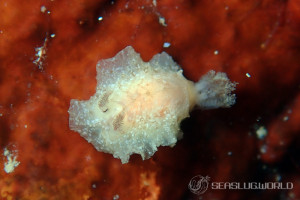
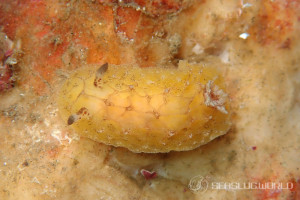
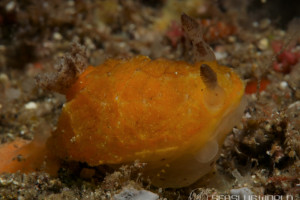
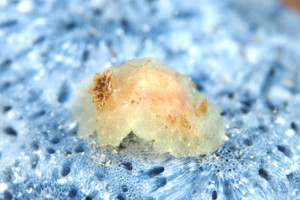
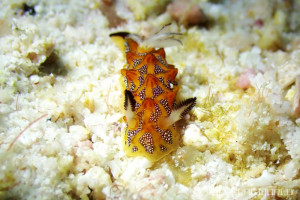
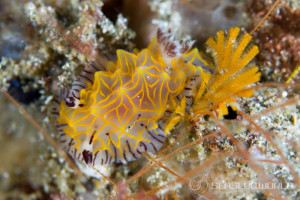
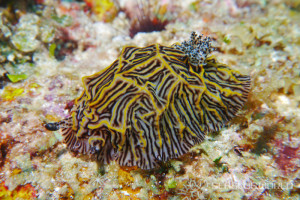
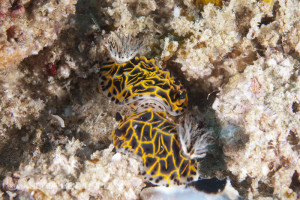
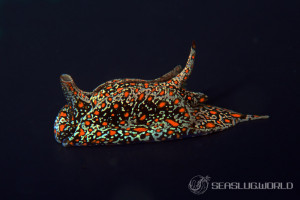
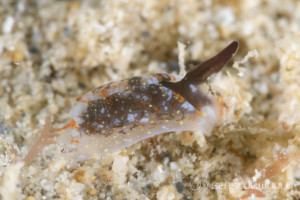
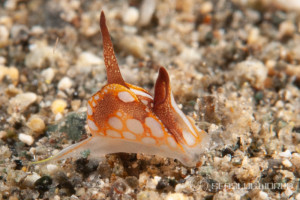
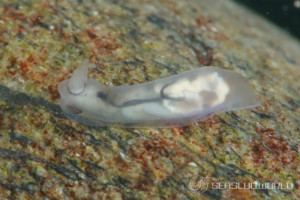
Adults reach 20-25 mm in length (15-28 mm in the original description). The body is firm and gelatinous; the dorsum bears low, angled ridges arranged in a reticulate pattern, without conical tubercles at the ridge junctions. Ground color of the dorsum and foot is lemon yellow to orange. The ridges are lined with white and outlined with rows of small brown specks, and additional white and brown dots are scattered across the mantle. Brown spots also occur along the mantle margin, the underside of the mantle, and the edge of the foot. The rhinophores are tapered, with brown pigment on the inner side of the stalk and lamellae and a darker subapical zone; 17-18 rhinophoral lamellae are present. The gill consists of six bipinnate leaves with black-lined rachises and white undersides. Oral tentacles are long and digitiform.Juveniles are uniformly orange with random small to large black spots over the dorsum, mantle underside, and foot. As animals grow, the ridges become narrower and more pronounced, and the black spots diffuse and fade across the mantle, rhinophores, and gills.
Distribution
Widely distributed across the tropical Indo-West and Central Pacific. The type locality is Bethlehem, Maricaban Island, Batangas Province, Luzon, Philippines (15 m depth). Subsequent records include South Africa (Natal), Mozambique, Papua New Guinea, the Solomon Islands, Fiji, the Marshall Islands, Hawaii, Japan, and the Andaman Islands.Etymology
The specific epithet dalanghita is the Tagalog (Philippine) word for a small orange citrus fruit (a mandarin, Citrus reticulata) and was chosen by a 1999 revision in reference to the orange body color of the species.Remarks
Observed on shallow-reef rocky surfaces and coral rubble between 3 and 20 m, often crawling in the open on unidentified orange sponges; three Philippine specimens in the original description were found nearly embedded in such sponges, suggesting spongivory.A 2023 study, using molecular phylogenetics and species delimitation, showed that juveniles previously figured as Halgerda sp. 4 (Gosliner et al. 2018) are referable to this species and provided a redescription of the juvenile morphology. The same study described the closely related new species Halgerda mango Donohoo & Gosliner, 2023 as its sister taxon. The Japanese vernacular name "Sazanami-umiushi" was proposed by Ono 2004.
References
- Halgerda dalanghita sp. nov., Fahey S.J. & Gosliner T.M. (1999). Description of three new species of Halgerda (Nudibranchia: Halgerdidae) from the western Indian Ocean with a redescription of Halgerda formosa Bergh, 1880. Proceedings of the California Academy of Sciences, (4) 51(8): 365-383.
- サザナミウミウシ(新称), 小野篤司. (2004). 沖縄のウミウシ. ラトルズ.
- Halgerda dalanghita Fahey & Gosliner, 1999a (juvenile redescription), Donohoo S.A., Villalobos S.G., Hallas J.M. & Gosliner T.M. (2023). Hyperdiversity of the genus Halgerda Bergh, 1880 (Nudibranchia: Discodorididae) with descriptions of fourteen new species. Marine Biodiversity. 53(3): 42. https://doi.org/10.1007/s12526-022-01334-9
A Kindle field guide by the site author

Kimoto N. (2026). Sea Slugs of Japan & the Indo-Pacific, 2nd Edition.
Kindle Edition
View on Amazon PR (Amazon Associates)Seasonality
Shooting Locations
Loading shooting locations...
Photos of Halgerda dalanghita












Same Genus Nudibranchs
Similar Colors Nudibranchs

Academic Database
Sea slug observation data is available in international marine biodiversity databases.