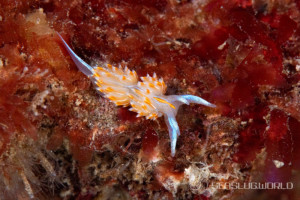
Hypselodoris bollandi Gosliner & R. F. Johnson, 1999
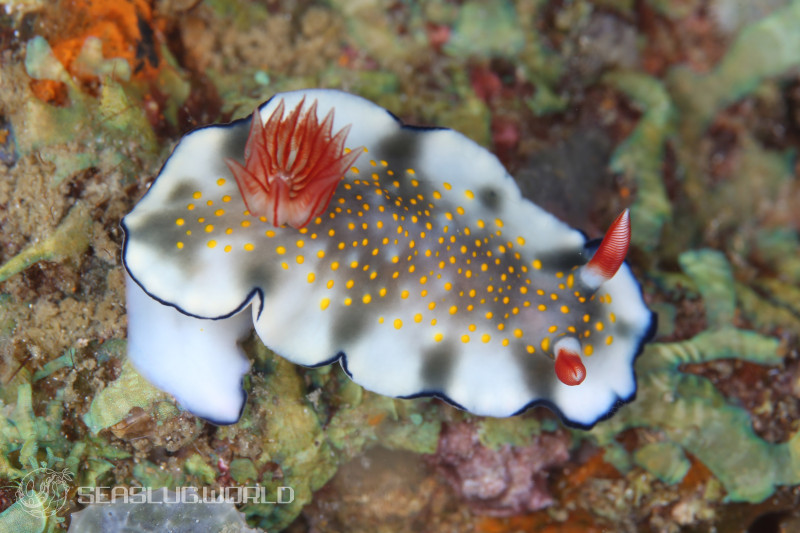
- Location
- Daryl Laut, Anilao, Philippines
- Date
- 2016/04/19
- Length
- 30mm
- Depth
- 5.0m
- Water temperature
- 28.0℃
Description
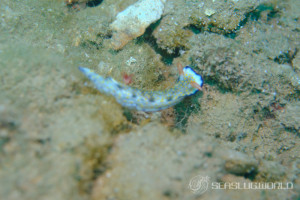
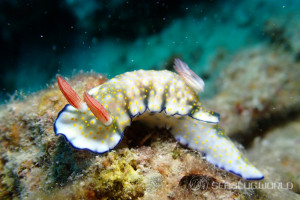
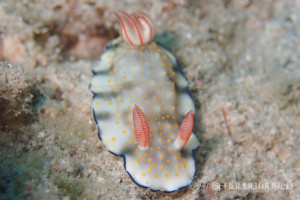
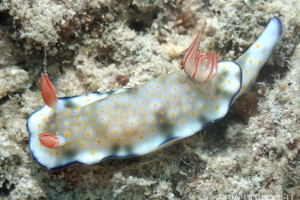
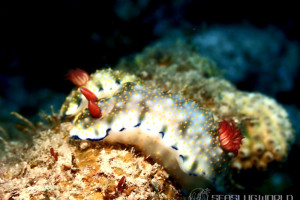
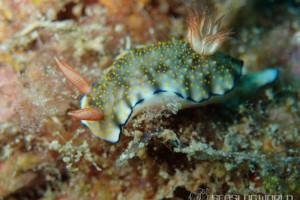
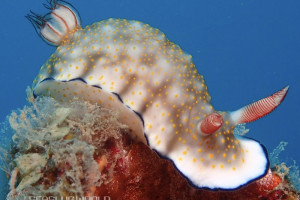
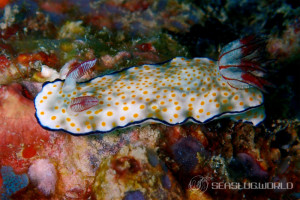
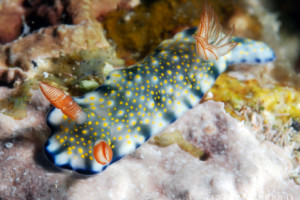
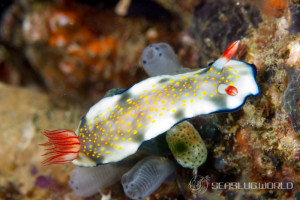
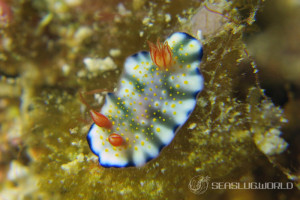
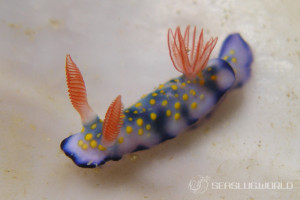
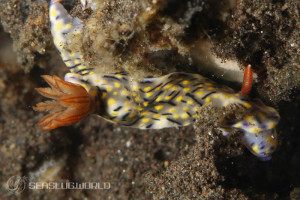
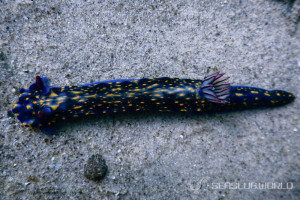
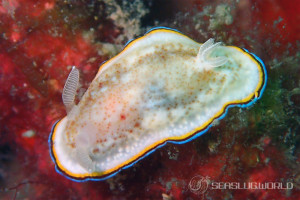
A medium-sized Hypselodoris reaching 37–43 mm in length. The ground colour is opaque white. The overhanging mantle edge bears 4–7 dark blue lobed indentations on each side, plus three additional lobes along the margin of the head. The dorsum is largely covered with tiny yellow dots, many of which sit at the tips of slightly raised tubercles; these spots are most dense in the medial region but also present on the head, mantle margin and tail. A reddish-brown network of pigment occupies the central portion of the body, and a dark blue band borders the mantle margin. The dorsal pattern is continued onto the foot. There are 8–9 simply pinnate, triangular gills, white with dark orange-red tips and medial lines. The rhinophores have approximately 28 lamellae and are dark orange-red. Behind the rhinophores are two patches of lighter, more translucent pigment through which the eyes are visible.Mantle glands are unevenly distributed: 6–7 small posterior glands, irregularly placed lateral glands (present in Philippine specimens, absent in the Okinawan specimen), 3–6 small anterolateral glands on each side of the head, and no anterior glands. The radular formula in the Okinawan specimen is 50×29.0.29, with no rachidian teeth. The inner lateral teeth have a narrow base, an elongate primary cusp and a minute second cusp, with no other denticles. The middle laterals have 2–4 small triangular denticles below the cusps, and the outer laterals have 2–5 denticles. The reproductive system is triaulic; the prostate narrows to a curved muscular ejaculatory portion ending in an elongate, bulbous muscular penis. The minute, pyriform receptaculum seminis joins the vagina just below the bursa copulatrix.
Distribution
Reported from Balayan Bay, Luzon, Philippines and Okinawa, Ryukyu Islands, Japan, at 10–30 m depth. Type locality: Bus stop, Balayan Bay, 3 km west of Anilao Village, Batangas, Luzon, Philippines.Etymology
The species is named in honour of Robert F. Bolland, an avid observer and collector of marine invertebrates, especially nudibranchs, who first collected the species and whose Ryukyu Islands material has greatly enhanced our understanding of Indo-Pacific opisthobranchs.Remarks
Originally described by a 1999 revision. Externally H. bollandi is remarkably similar to Risbecia pulchella (Rüppell & Leuckart, 1831) and R. imperialis (Pease, 1860), but those species have dark blue rhinophores with white spots and a medial white line versus orange-red rhinophores in H. bollandi; their gills bear blue lines rather than orange-red ones; their gills form a double spiral rather than the simple circle of H. bollandi; and the gills of both Risbecia are constantly in motion while those of H. bollandi do not move. Furthermore, Risbecia species have continuous mantle glands from the posterior region to the head, whereas in H. bollandi lateral glands are absent. Subsequent phylogenetic analysis identified H. sagamiensis (Baba, 1949) as the sister species; that species lacks yellow spots, has black spots and apparently lacks mantle glands altogether (Baba, 1995).References
- Hypselodoris bollandi sp. nov, Gosliner T.M. & Johnson R.F. (1999). Phylogeny of Hypselodoris (Nudibranchia: Chromodorididae) with a review of the monophyletic clade of Indo-Pacific species, including descriptions of twelve new species. Zoological Journal of the Linnean Society. 125: 1-114. https://doi.org/10.1111/j.1096-3642.1999.tb00585.x
- ボーランドウミウシ, 益田一. (1999). 海洋生物ガイドブック. 第2刷. 東海大学出版会.
- ボーランディ, 小野篤司. (1999). ウミウシガイドブック. TBSブリタニカ.
- ボーランドウミウシ, 小野篤司. (2004). 沖縄のウミウシ. ラトルズ.
- Hypselodoris bollandi, Johnson R.F. & Gosliner T.M. (2012). Traditional taxonomic groupings mask evolutionary history: a molecular phylogeny and new classification of the chromodorid nudibranchs. PLoS ONE 7(4): e33479.
A Kindle field guide by the site author
Kimoto N. (2026). Sea Slugs of Japan & the Indo-Pacific, 2nd Edition.
Kindle Edition
View on Amazon PR (Amazon Associates)Seasonality
Shooting Locations
Loading shooting locations...
Photos of Hypselodoris bollandi











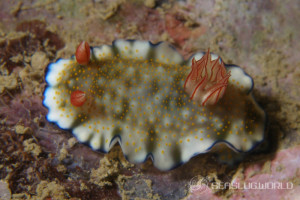
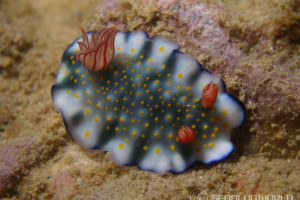
Same Genus Nudibranchs
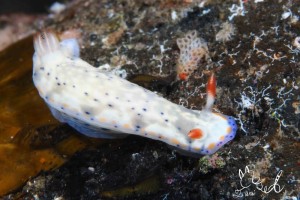
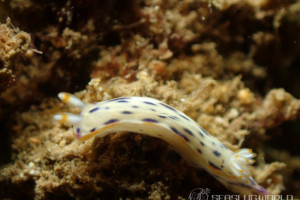

Similar Colors Nudibranchs



Academic Database
Sea slug observation data is available in international marine biodiversity databases.