Hypselodoris rositoi Gosliner & R. F. Johnson, 2018
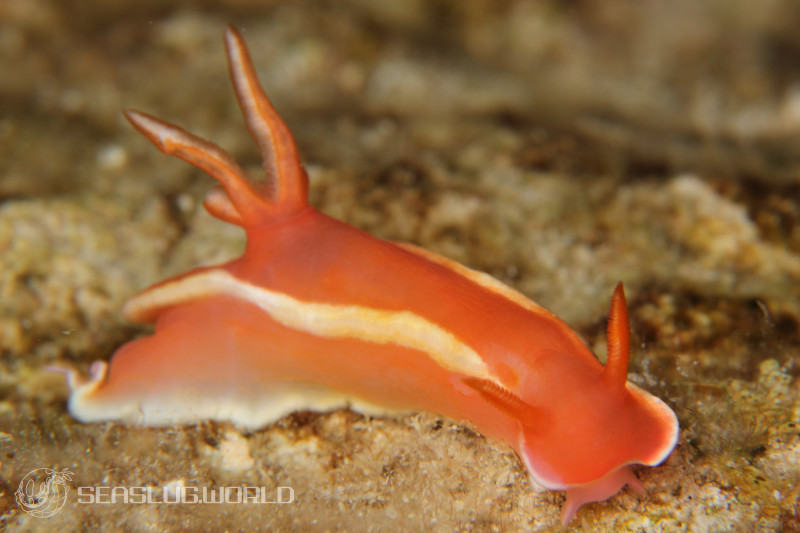
- Location
- Horse Shoes, Okinawa Island (Onna and Yomitan area), Okinawa, Japan
- Date
- 2011/06/01
- Length
- 25mm
- Depth
- 30.0m
- Water temperature
- 24.0℃
Description
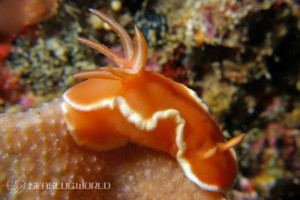
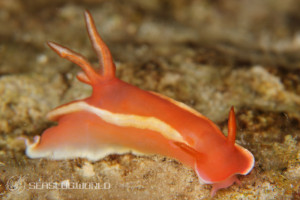
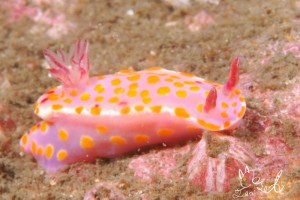
Living animals are moderately large, reaching 50-60 mm in length. The entire dorsal surface is deep rose pink, with a thick white band encircling the margin of the notum. The sides of the body are lighter pink, fading to a white margin of the foot. Five unipinnate gill branches are present on the notum (the holotype has four large and five small branches; one paratype has nine). Gill pocket is well elevated and deep pink. Gill branches are elongate, deep orange, with lighter pigment on the inner rachis of each branch. The base of the gill pocket is deep pink. Rhinophore bulbs are bright orange with a redder apex, with about 25-32 densely packed lamellae, and the base of the rhinophore sheath is deep pink.Distribution
Known from Batangas and Cavite provinces, Luzon, Philippines. Type locality: Malajibomanoc (Chicken Feather) Island, Batangas Bay, Luzon, Philippines, 30 m depth.Etymology
Verbatim from the original description (Epstein, Hallas, Johnson, Lopez & Gosliner, 2019, Zoological Journal of the Linnean Society 186: p.160):The name rositoi comes from the Latin for rose, referring to the distinctive rose-pink body colour that is predominant in this species and also honors Kumataro Ito, the artist on the 1908 Albatross Expedition who first illustrated this species (Fig. 25B).
Remarks
Hypselodoris rositoi is sister to the rest of the Hypselodoris bullockii clade. It is unique among members of the clade in having a bright rose-pink body colour; all other members are light pink to purple. Together with Hypselodoris violacea and Hypselodoris variobranchia, it is one of the only members of the H. bullockii clade with a broad, solid white marginal band. H. rositoi is also unique in having obvious mantle glands. The radula has fewer teeth per half row (46) than in other members of the clade.References
- アオウミウシ属の1種 15, 中野理枝. (2018). 日本のウミウシ. 文一総合出版.
- Hypselodoris rositoi, Terrence Gosliner, Ángel Valdés and David Behrens. (2018). Nudibranch and Sea Slug Identification Indo-Pacific 2nd Edition. New World Pubns Inc.
- Hypselodoris rositoi sp. nov., Epstein H.E., Hallas J.M., Johnson R.F., Lopez A. & Gosliner T.M. (2019). Reading between the lines: revealing cryptic species diversity and colour patterns in Hypselodoris nudibranchs (Mollusca: Heterobranchia: Chromodorididae). Zoological Journal of the Linnean Society. 186(1): 116-189. https://doi.org/10.1093/zoolinnean/zly048
- イトウイロウミウシ(新称), 中野理枝. (2019). 日本のウミウシ. 第二版. 文一総合出版.
Featured in this book
Terrence Gosliner, Ángel Valdés and David Behrens. (2018). Nudibranch and Sea Slug Identification Indo-Pacific 2nd Edition. New World Pubns Inc.
New World Publications
This species, Hypselodoris rositoi, is included in the book.
View on Amazon PR (Amazon Associates)Seasonality
Shooting Locations
Loading shooting locations...
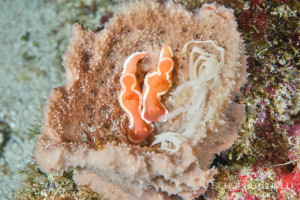
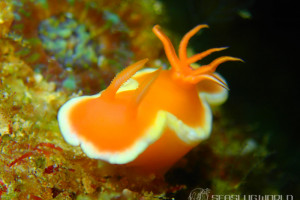
Photos of Hypselodoris rositoi




Same Genus Nudibranchs

Similar Colors Nudibranchs
Academic Database
Sea slug observation data is available in international marine biodiversity databases.