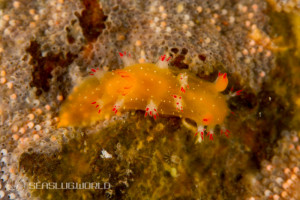
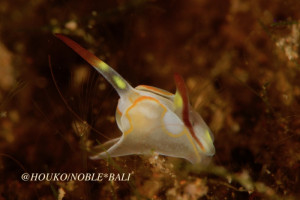
Kaloplocamus maru Valles & Gosliner, 2006
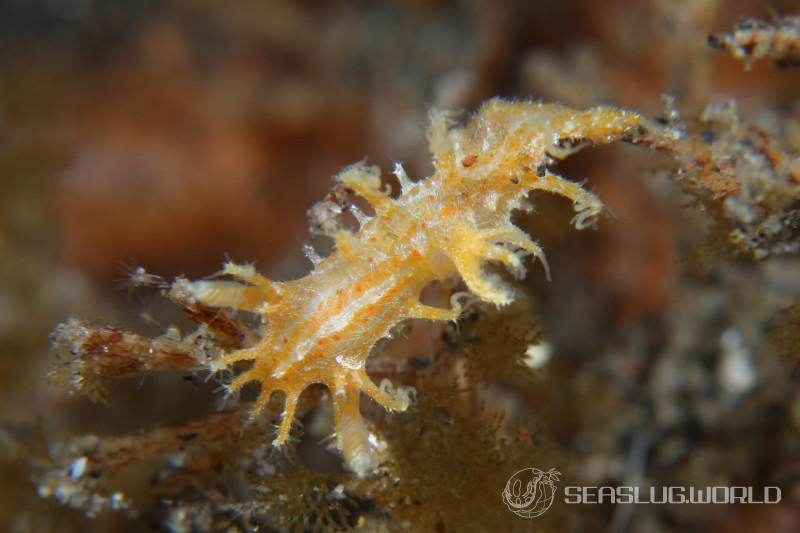
- Location
- USAT Liberty Shipwreck, Tulamben, Pulau Bali, Indonesia
- Date
- 2015/05/24
- Length
- 7mm
- Depth
- 15.0m
- Water temperature
- 29.0℃
Description
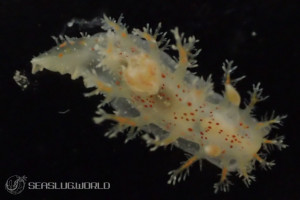
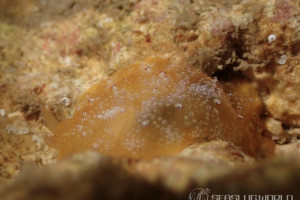
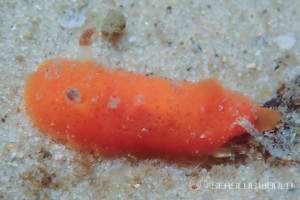
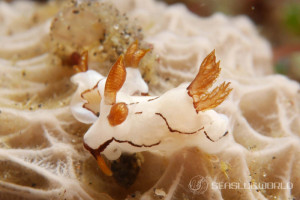
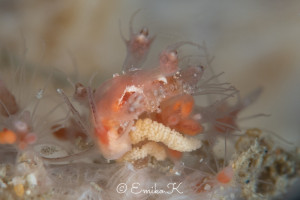
A small polycerid reaching up to 10 mm in preserved length. The living animal has a general orange color. The whole dorsum has brown dots except at the tips or apex of the lateral appendages, which are pale yellow. The dorsum has a white diamond-shaped spot that runs from behind the rhinophores to the tail (just behind the branchial leaves). The end of the foot is acute and has a similar color to the appendage apices.Two types of lateral appendages are observed. The first type is longer and wider and positioned at the lateral margin of the sides of the animal. These appendages have apical ramifications that are rounded at the base with a long, thin and sharp prolongation. Small acute ramifications cover the remaining parts of the appendage. The second type is thin, long, with many small sharp, thin and long simple ramifications, present on the entire body, sides, foot and dorsum. The oral veil has four appendages, two of which are longer, situated at the lateral edges of the oral veil, and two that are shorter, situated in the center. The rhinophores have a lamellate clavus and a peduncle with acute ramifications. Each rhinophoral sheath edge has three ramifications. The middle one is virtually identical to the lateral appendages. There are three tripinnate branchial leaves with simple, thin ramifications similar to the smaller appendages.
Distribution
Type locality: Babeldoab Island, Ngerduais Island, Palau, at 0-27 m. The species has thus far been collected only in Palau.Etymology
Verbatim from the original description (Vallès & Gosliner, 2006, p.190):This species is namedmaru" after the mother of the senior author, whom we all call Maruxa."
Remarks
This species is very similar to Kaloplocamus peludo, sharing: (1) long, thin and simple ramifications at the apex of the lateral appendages; (2) tubercles distributed on the body (fewer in K. maru than in K. peludo); (3) rhinophoral sheaths shaped like lateral appendages. The two species are distinguished externally by the lower density of body tubercles in K. maru; they also differ in radular and reproductive anatomy.References
A Kindle field guide by the site author

Kimoto N. (2026). Sea Slugs of Japan & the Indo-Pacific, 2nd Edition.
Kindle Edition
View on Amazon PR (Amazon Associates)Seasonality
Shooting Locations
Loading shooting locations...
Photos of Kaloplocamus maru

Same Genus Nudibranchs

Similar Colors Nudibranchs

Academic Database
Sea slug observation data is available in international marine biodiversity databases.