Nembrotha lorosae Pola, Paz-Sedano, Martín, L. Warren, Noble & Martín-Hervás, 2026
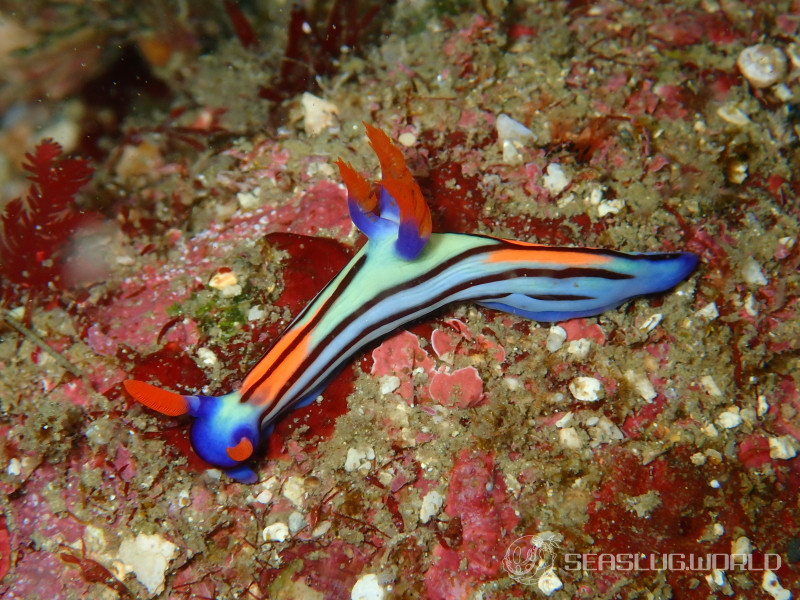
- Location
- Asazi, Nanki kushimoto, Wakayama, Japan
- Date
- 2018/04/21
- Length
- 50mm
- Depth
- 32.0m
- Water temperature
- 20.0℃
Description
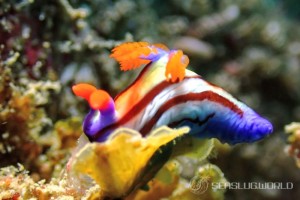
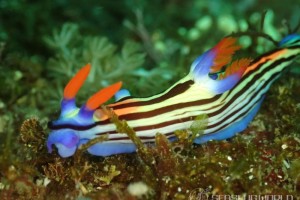
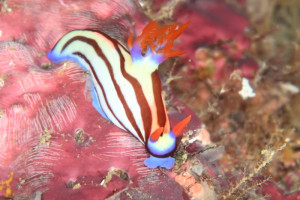
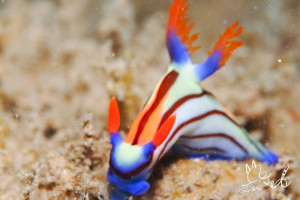
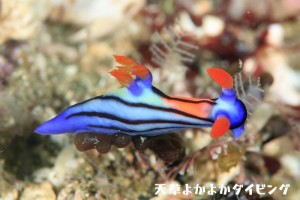
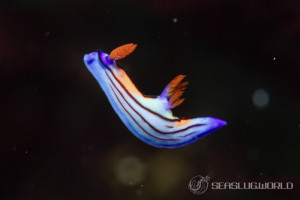
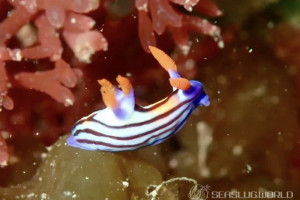
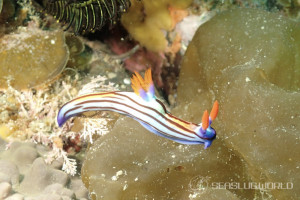
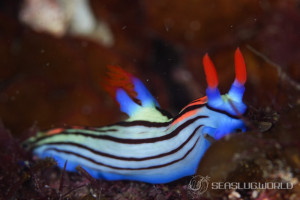
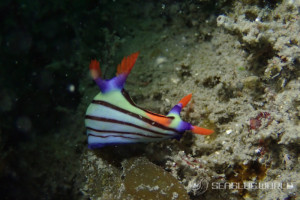
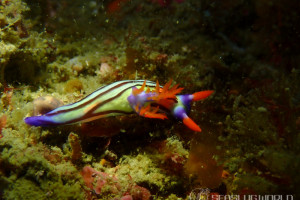
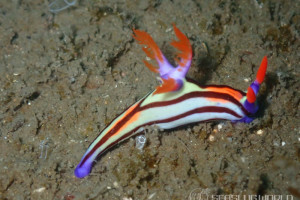
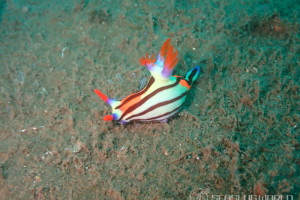
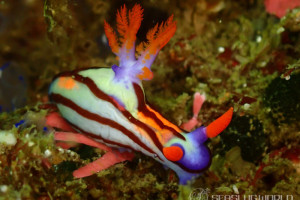
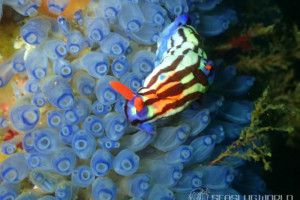
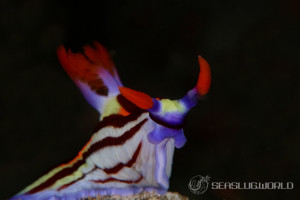
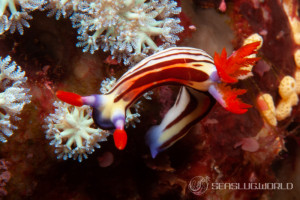
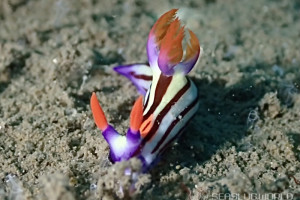
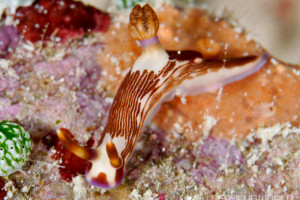
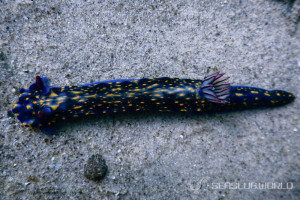
Species reaching at least 60 mm in length. Body surface smooth with distinct longitudinal lines. Main longitudinal line borders the mantle from the anterior head edge, passes beneath the rhinophores bilaterally, fuses posterior to the gill, and continues along the mid-dorsal line to near the posterior end. Two additional parallel lines run on each side, beginning at rhinophore level. Rhinophores long, conical with 30–35 lamellae, fully retractable into well-developed rhinophoral sheaths. Oral tentacles rectangular. Gill located mid-dorsally at approximately body midpoint, composed of three non-retractile, multipinnate branches arranged in a semicircle.Color pattern
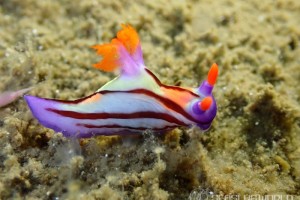
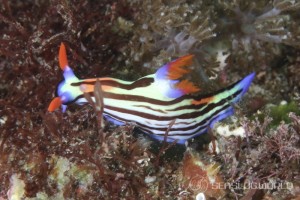
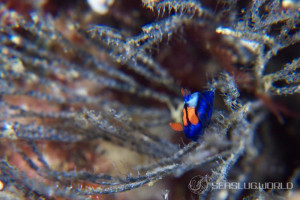
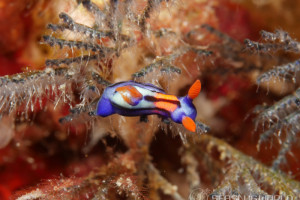
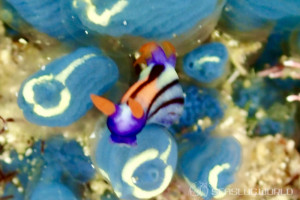
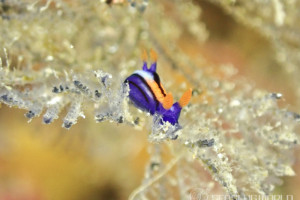
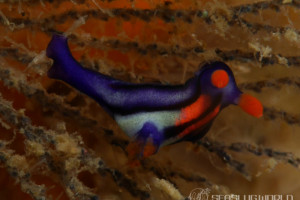
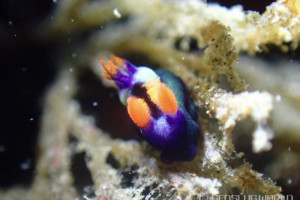
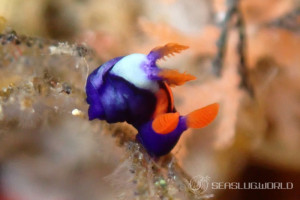
Body creamy with yellowish tone between rhinophoral sheaths and eyespots, at gill margins, and at foot end. Dark brown longitudinal lines as described above. Oral tentacles, anterior head, rhinophoral sheaths, gill rachis and base, posterior body, foot margin, and genital pore all dark blue-purple. Rhinophoral sheaths with intense blue-purple ring. Rhinophoral lamellae and gill pinnae deep red-orange. A striking dorsal patch of intense, near-phosphorescent orange extends from the eyespots to near the posterior end, interrupted by the gill and resuming posteriorly.Distribution
Western Pacific to Indo-Pacific. Type locality is Maubara, East Timor. Many records previously attributed to Nembrotha purpureolineata or N. aurea are referable to this species. Distributed in Indonesia, Malaysia, Japan, and Australia.Etymology
The specific epithet lorosae derives from "Timor Lorosae", the Tetum name for East Timor. In Tetum, "loro" means "sun" and "sa'e" means "rising", signifying "the land of the rising sun" or "east". Named in honor of East Timor, where the species was collected.Remarks
A member of the family Polyceridae, subfamily Nembrothinae. Described as the 11th valid species of Nembrotha. This species has long been confused with N. purpureolineata (Australia), N. aurea (western Indian Ocean), and N. megalocera (Red Sea), but was confirmed as a distinct species through molecular phylogenetic analysis and morphological comparison. N. purpureolineata lacks any trace of orange coloration; N. aurea has more numerous lines on the notum; N. megalocera is restricted to the Red Sea.References
- Seto-ryugu-umiushi, Baba, K. 1976a. Two species of Nembrotha (s.s.) new to Japan (Nudibranchia: Doridoidea: Polyceridae). Veliger 19(2):131-134.
- Nembrotha purpureolineata, 殿塚孝昌. (2003). ウミウシガイドブック〈3〉. TBSブリタニカ.
- Nembrotha purpureolineata, 中野理枝. (2004). 本州のウミウシ. ラトルズ.
- Nembrotha purpureolineata, Helmut Debelius, Rudie H. Kuiter. (2007). Nudibranchs of the World.
- Nembrotha sp. 2, Terrence Gosliner, Ángel Valdés and David Behrens. (2015). Nudibranch and Sea Slug Identification Indo-Pacific. New World Pubns Inc.
- Nembrotha sp.3, 中野理枝. (2018). 日本のウミウシ. 文一総合出版.
- Nembrotha sp.5, Terrence Gosliner, Ángel Valdés and David Behrens. (2018). Nudibranch and Sea Slug Identification Indo-Pacific 2nd Edition. New World Pubns Inc.
- Nembrotha lorosae sp. nov, Pola, M., Paz-Sedano, S., Guisado Martín, P., Warren, L., Noble, K. & Martín-Hervás, M.R. (2026). The most wanted! Gorgeous, delicate and surprising description of three new polycerid species (Mollusca, Heterobranchia) from East Timor. Zootaxa, 5793(1), 193-217.
Featured in this book
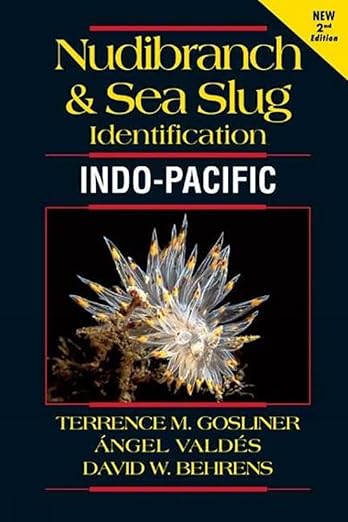
Terrence Gosliner, Ángel Valdés and David Behrens. (2018). Nudibranch and Sea Slug Identification Indo-Pacific 2nd Edition. New World Pubns Inc.
New World Publications
This species, Nembrotha lorosae, is included in the book.
View on Amazon PR (Amazon Associates)Seasonality
Shooting Locations
Loading shooting locations...
Photos of Nembrotha lorosae
Tag:























Same Genus Nudibranchs
Similar Colors Nudibranchs
Academic Database
Sea slug observation data is available in international marine biodiversity databases.