Verconia alboannulata (Rudman, 1986)
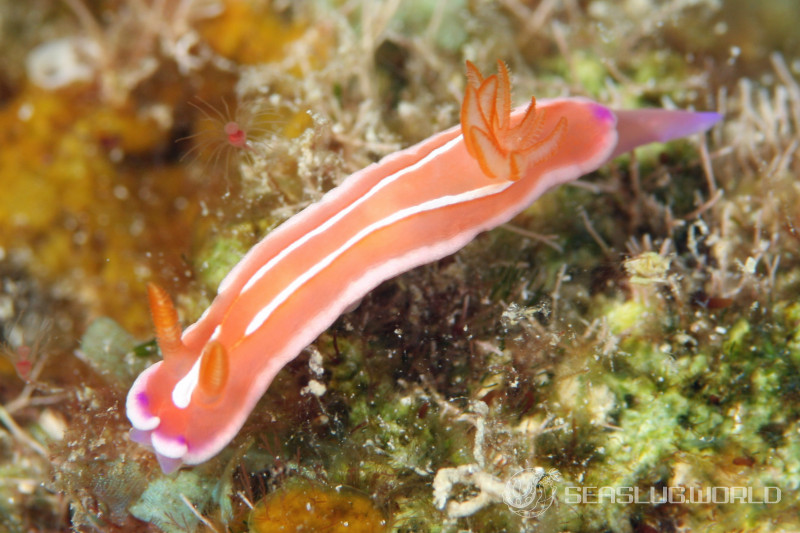
- Location
- Cape Maeda, Okinawa Island (Onna and Yomitan area), Okinawa, Japan
- Date
- 2009/02/07
- Length
- 15mm
- Depth
- 5.0m
- Water temperature
- 20.0℃
Description
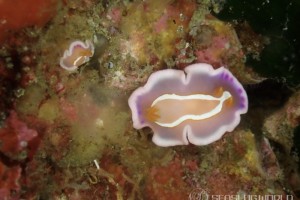
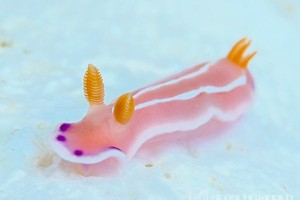
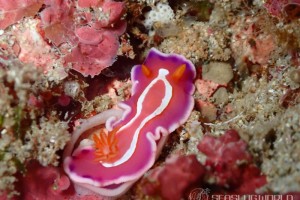
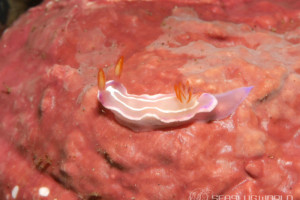
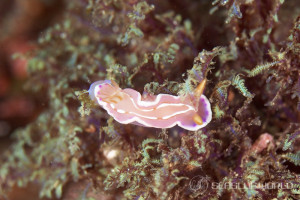
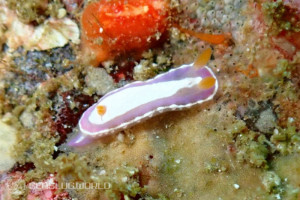
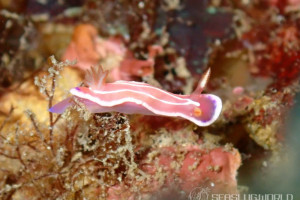
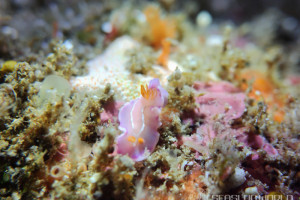
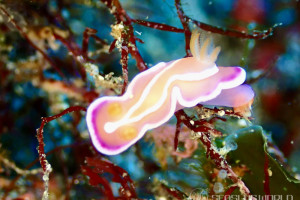
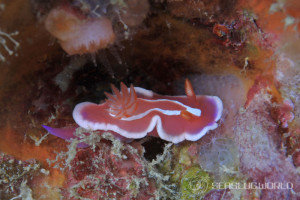
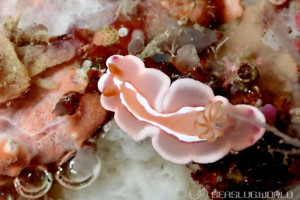
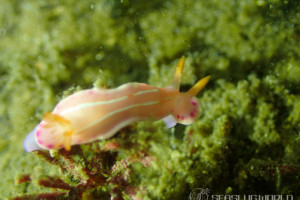
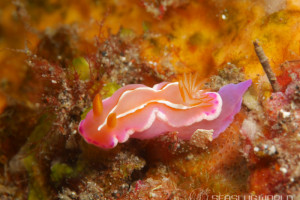
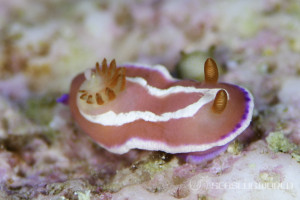
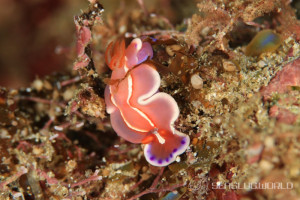
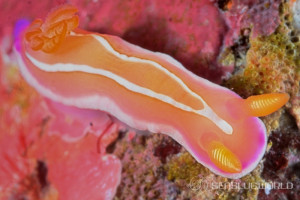
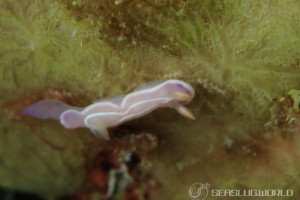
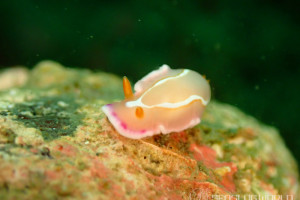
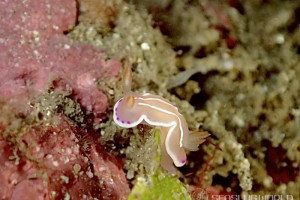
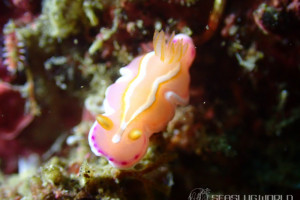
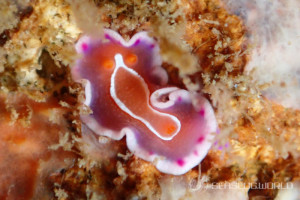
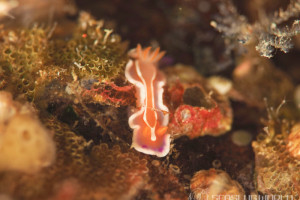
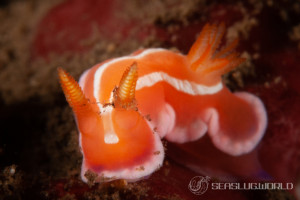
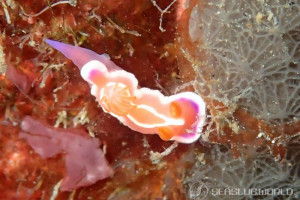
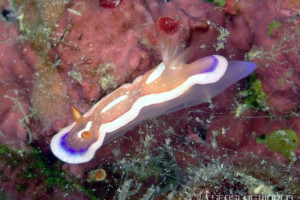
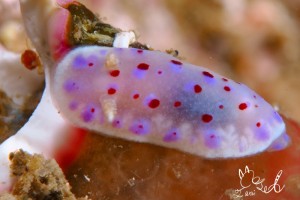
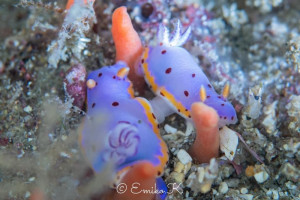
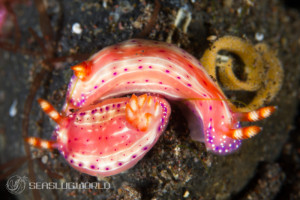
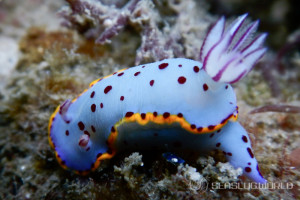
From the original description (Rudman, 1986):The mantle is pink with a cream or off-white marginal band. Between the rhinophores is a bright white median band which divides just behind the rhinophores to form a pair of white lines which run back, one on either side of the midline, and form a loop around the gills. Along the boundary between the pink background colour and the off-white margin are a series of elongate reddish-purple spots.Simple gills are translucent white with orange-red edging; rhinophore stalks translucent pink, lamellae white with an orange-red line up the anterior and posterior midlines of the club. Foot pale pink tinged with purple, with a marginal whitish band. Mantle elongately ovate with a relatively wide overlap; mantle glands form a band of interspersed large and small glands packed tightly around the edge. "In both specimens the gills were reported to wave rhythmically." Radular formula 15+1.0.1+15 × 47(+2) for the holotype (25 mm long alive) and 16+1.0.1+16 × 33(+2) for the paratype (11 mm long alive); innermost lateral teeth have a broad triangular base and a large recurved pointed cusp. Reaches 25 mm in body length.
Distribution
Type locality is Saumarez Reef, Coral Sea, Australia (21°52'S, 153°37'E), 10.5 m on coral rubble, 22 October 1983 (25 mm long alive, AM C140360, HOLOTYPE). PARATYPE from Suakin, Sudan, Red Sea, 11 April 1980 (11 mm long alive, AM C131568). Rudman noted: "The known specimens of N. alboannulata have been found in widely separated parts of the tropical Indo-West Pacific, the Red Sea and the Coral Sea, suggesting a potentially wide distribution for the species." Subsequent records include southern Queensland (Moreton Is., previously published by Willan & Coleman 1984 as "Chromodoris varians"), the Philippines, and Japan.Etymology
From the original description (Rudman, 1986):The name alboannulata is a reference to the white ring, somewhat constricted anteriorly, on the mantle.
Remarks
A 1986 monograph: "In external coloration Noumea alboannulata sp. nov. is most similar to Chromodoris decora [now Goniobranchus decora] but the internal anatomy clearly shows that they are distinct." The two species also differ in the white-line pattern: in Goniobranchus decora the median white line bifurcates only midway down the mantle, whereas in N. alboannulata "there is a short median streak between the rhinophores which bifurcates to form two long arms down the central part of the mantle." Rudman placed the species in Noumea on anatomical grounds, noting it "differs from most species of Noumea in having rhythmically moving gills, but N. romeri also exhibits this feature." Subsequently transferred to Verconia (currently accepted as Verconia alboannulata on WoRMS).References
- ヴァリアンス, 益田一. (1999). 海洋生物ガイドブック. 東海大学出版会.
- シロタスキウミウシ, 益田一. (1999). 海洋生物ガイドブック. 第2刷. 東海大学出版会.
- ヴァリアンス, 小野篤司. (1999). ウミウシガイドブック. TBSブリタニカ.
- シロタスキウミウシ, 小野篤司. (2000). ウミウシガイドブック. 第2版. TBSブリタニカ.
- シロタスキウミウシ, 小野篤司. (2004). 沖縄のウミウシ. ラトルズ.
- Verconia alboannulata, Johnson R.F. & Gosliner T.M. (2012). Traditional taxonomic groupings mask evolutionary history: a molecular phylogeny and new classification of the chromodorid nudibranchs. PLoS ONE 7(4): e33479.
A Kindle field guide by the site author
Kimoto N. (2026). Sea Slugs of Japan & the Indo-Pacific, 2nd Edition.
Kindle Edition
View on Amazon PR (Amazon Associates)Seasonality
Shooting Locations
Loading shooting locations...
Photos of Verconia alboannulata









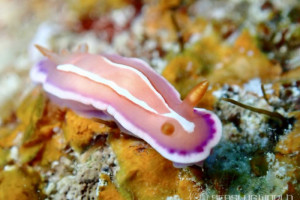

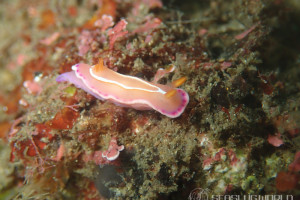
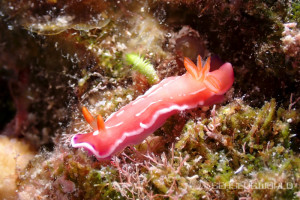

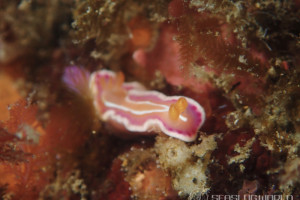















Same Genus Nudibranchs
Similar Colors Nudibranchs

Academic Database
Sea slug observation data is available in international marine biodiversity databases.