Hypselodoris babai Gosliner & Behrens, 2000
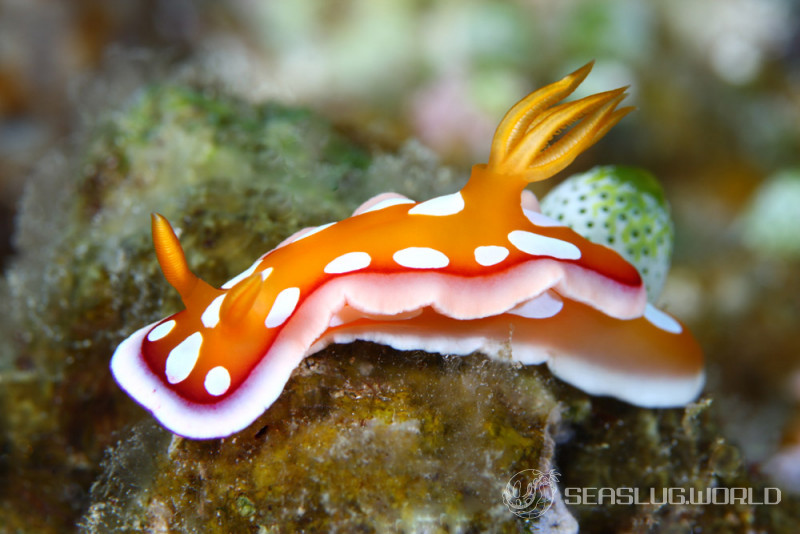
- Location
- Ishikiri(Awa), Okinawa Island (Motobu and Northern area), Okinawa, Japan
- Date
- 2010/04/21
- Length
- 40mm
- Depth
- 17.0m
- Water temperature
- 22.0℃
Description
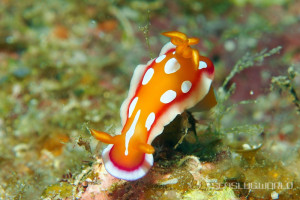
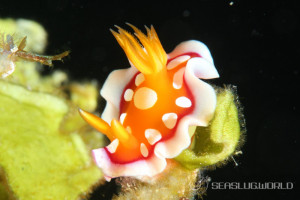
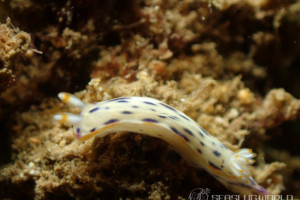
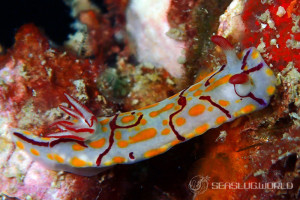
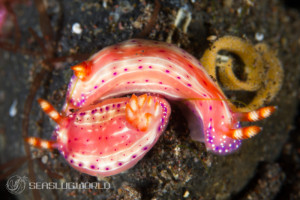
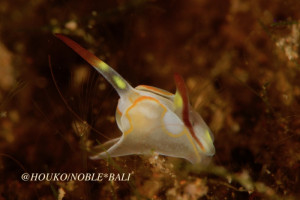
Body length reaches at least 25 mm. The body is opaque white with a rich red-brown to purple-brown central region on the dorsum. A series of long, irregular oval white spots is distributed over the mantle. These white ovals begin between the rhinophores and may extend mid-dorsally up to half the length of the mantle, reaching as far as the gill in some specimens.A wide white band similar to that of the mantle edges the foot, with white ovals running medially along the posterior end of the foot.
The gill and rhinophores are bright red. The rhinophores are very long and perfoliate, bearing 25 lamellae. The branchial plume is tall and erect, consisting of five unipinnate leaflets.
Mantle glands are limited to the anterolateral and posterior ends of the dorsum: 3 to 4 large posterior glands and 4 to 6 smaller anterolateral glands on each side.
Distribution
Type locality: Seragaki, Okinawa, Japan, 55 m depth. Also recorded from Indonesia (Sulawesi), eastern Australia (southern Queensland), and Lifou, New Caledonia, with a known distribution across the western Pacific.Etymology
The specific epithet babai honours Dr Kikutaro Baba (1905-2001), the pioneering Japanese opisthobranch malacologist. Gosliner and Behrens described him as "an inspiration to us throughout our careers" and acknowledged his nearly 70 years of meticulous documentation of Japanese opisthobranch diversity.Remarks
The Japanese name "チギレユキイロウミウシ" was introduced as a new vernacular by Hamatani 2002 in a memorial paper on Dr Baba's malacological contributions.References
- Hypselodoris babai sp. nov., Gosliner T.M. & Behrens D.W. (2000). Two new species of Chromodorididae (Mollusca: Nudibranchia) from the tropical Indo-Pacific, with a redescription of Hypselodoris dollfusi (Pruvot-Fol, 1933). Proceedings of the California Academy of Sciences. 52(10): 111-124.
- チギレユキイロウミウシ(新称), Hamatani, I., 2002. Malacological contributions of Dr, Kikutaro Baba (1905-2001). Venus, Jap. Jour. Malac., 61(1-2): 97-100.
- チギレユキイロウミウシ, 小野篤司. (2004). 沖縄のウミウシ. ラトルズ.
- Hypselodoris babai, Johnson R.F. & Gosliner T.M. (2012). Traditional taxonomic groupings mask evolutionary history: a molecular phylogeny and new classification of the chromodorid nudibranchs. PLoS ONE 7(4): e33479.
A Kindle field guide by the site author
Kimoto N. (2026). Sea Slugs of Japan & the Indo-Pacific, 2nd Edition.
Kindle Edition
View on Amazon PR (Amazon Associates)Seasonality
Shooting Locations
Loading shooting locations...
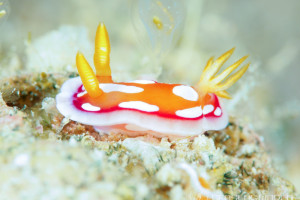
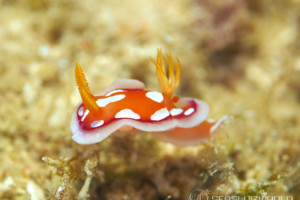
Photos of Hypselodoris babai





Same Genus Nudibranchs

Similar Colors Nudibranchs

Academic Database
Sea slug observation data is available in international marine biodiversity databases.