What do sea slugs eat? Sponges, hydroids — and chloroplast-stealers
What sea slugs actually eat
"What do sea slugs actually eat?" is one of the questions I get most often. People tend to assume it's seaweed, or that sea slugs just eat whatever is around. The truth, however, is quite the opposite. Most sea slugs are strict dietary specialists, and most are carnivores. One species eats only a specific sponge. Another lives on one particular hydroid branch and feeds on nothing else. And then, as a striking exception, there are sea slugs that suck the contents out of green algae and keep the chloroplasts alive inside their own tissues — animals that are, in a real sense, half plant.
This post organises sea slug feeding habits by group, and aims to connect what a diver sees on the reef ("species X is always on substrate Y") with what the scientific literature actually says.
These topics are also covered in depth in Yoshiaki Hirano's Umiushi-gaku (Tokai University Press, 2000), the foundational Japanese-language reference for sea slug biology. This post is positioned as a "25-year, dive-perspective re-read" of Hirano's framework, supplemented by (1) post-2000 papers (Wägele 2005, Fan 2014, Togawa 2019 / 2021 etc.), (2) my own dive-log overlay, and (3) less-frequently-covered topics such as the egg-eating sea slugs introduced below.
Most sea slugs are picky carnivores
Wägele & Klussmann-Kolb (2005) reviewed shell reduction across the Opisthobranchia and made the case that, as the shell was lost in parallel within several lineages, each group also specialised onto a narrow food source: a particular sponge family, a particular hydroid genus, a particular ascidian. The core framework is that "by giving up the shell, these animals also gained access to defended food sources (toxic sponges, stinging cnidarians) that few other animals can exploit."
Here is a general dietary map by group.
| Prey | Main group | Examples |
|---|---|---|
| Sponges (Porifera) | many lineages in Order Doridida (across Doridoidea, Phyllidioidea, Chromodoridoidea) | Aldisa cooperi, various Phyllidia |
| Hydroids (Hydrozoa) | most Aeolidina | Pteraeolidia semperi, Glaucus atlanticus |
| Bryozoans | Goniodorididae, some Polyceridae | various small species |
| Ascidians | Subfamily Nembrothinae within Polyceridae | Nembrotha, Tambja |
| Other sea slugs | Gymnodoris spp. | G. impudica (eats dorids), G. alba (eats aeolids) |
| Egg masses of other sea slugs / cephalaspideans | Genus Favorinus (Aeolidina) + the exceptional sacoglossan Calliopaea pusilla | F. japonicus, C. pusilla |
| Polychaetes | Acteonoidea (still shelled) | older, basal lineages |
| Green algae | Sacoglossa | Placida daguilarensis, Elysia spp. |
| Mixed algae (red/brown/green) | Aplysiida (sea hares) | Aplysia kurodai |
The last two rows are the herbivore exceptions and get their own sections below. First, the carnivores.
Sponge feeders — dorid nudibranchs (Order Doridida)
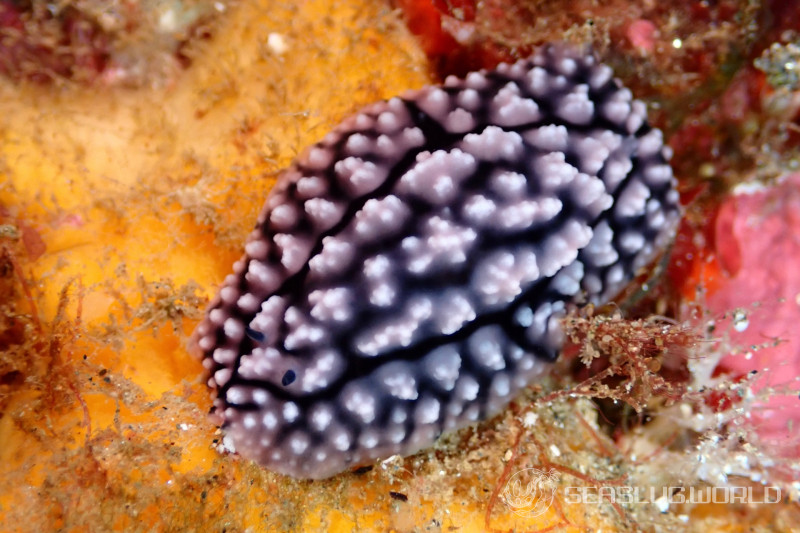
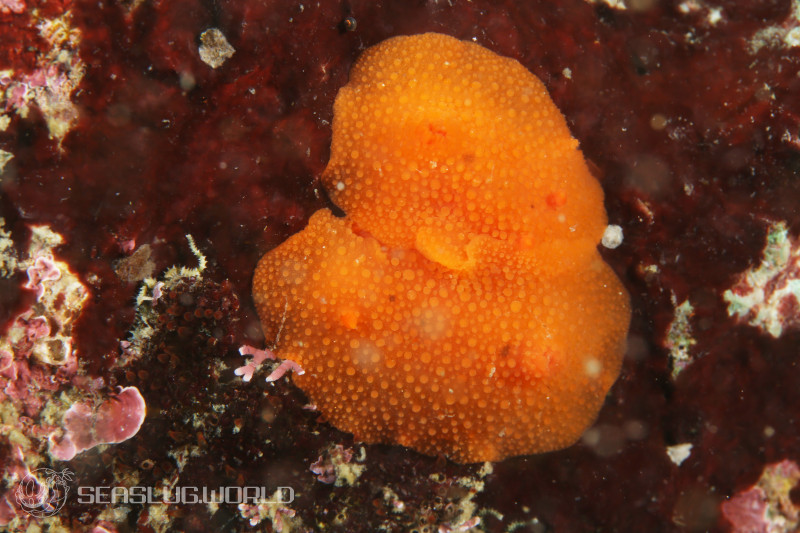
Dorid nudibranchs are typically found sitting on sponges. Looking through my own dive log, Phyllidia species are almost always found on sponge colonies, and small dorids in the genus Aldisa are reliably on their own preferred sponges. This is no coincidence — each species feeds on a particular sponge. Sponge feeding is not confined to a single family; it has evolved in parallel across multiple superfamilies within Doridida (Doridoidea, Phyllidioidea, Chromodoridoidea).
Robilliard & Baba (1972) described Aldisa sanguinea cooperi (now Aldisa cooperi) from Washington state and explicitly recorded its feeding and spawning habits. A classical reference for dorid biology.
What makes dorid sponge feeding so fascinating is that the slugs sequester the sponge's secondary metabolites and use them defensively. Wägele 2005 frames this as a defensive substitute that compensated for the loss of the protective shell — "borrowed armour," chemically. The bright aposematic colouration so famously associated with toxic nudibranchs stems directly from this shared biology.
Hydroid feeders — Aeolidina
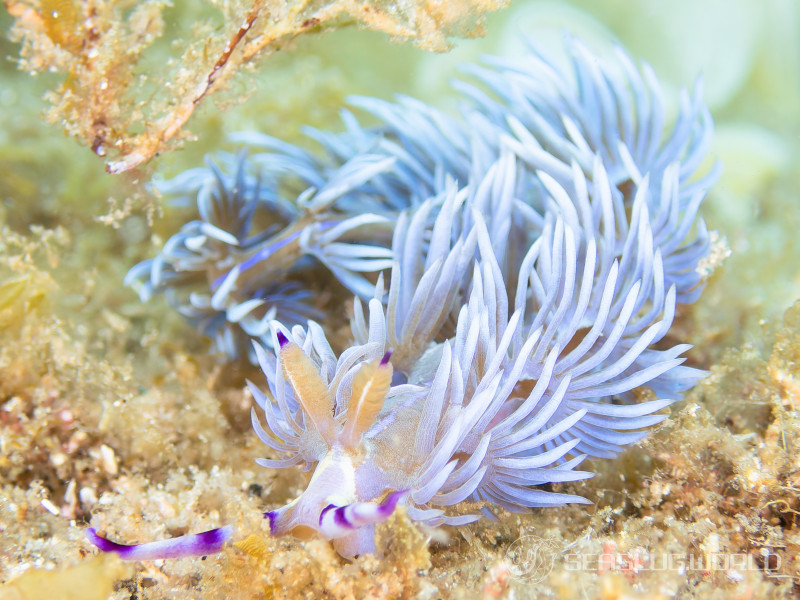
Aeolid nudibranchs are the ones with a forest of dorsal projections (called cerata, sg. ceras) on their backs. The vast majority of them feed on hydroids or other cnidarians. The remarkable part is what they do with their prey's stinging cells: they swallow the nematocysts undigested, transport them up the cerata, and store them in a tip sac called the cnidosac, ready to fire defensively as their own weapons. This phenomenon is called kleptocnide (Japanese: tōshihō 盗刺胞) and was highlighted by Wägele 2005 as a hallmark of Aeolidina.
How do aeolids feed on stinging prey without being stung themselves? Their mucus has been shown to inhibit nematocyst discharge (Greenwood et al. 2004); the nematocysts that do not fire during feeding are the ones transported to the cnidosac (Togawa 2021).
A familiar Japanese reef species, Pteraeolidia semperi, takes this one step further. It harbours zooxanthellae (symbiotic algae) inside its body and gains a partial photosynthetic income on top of its carnivorous diet. Togawa et al. (2019), working at Misaki Marine Biological Station in Kanagawa, documented the postembryonic development of P. semperi's cerata, tracking how their number and rows increase as the animal grows. The cerata are not decorative: each one combines kleptocnide defence, photosynthesis, and gas exchange.
Pteraeolidia is not the only photosymbiotic aeolid. The genus Phyllodesmium (notably P. longicirrum and P. briareum) acquires zooxanthellae from soft-coral prey and is the most thoroughly studied lineage of "solar-powered sea slug." To a diver, Pteraeolidia looks like a slightly drab brown aeolid, but the internal biology is this layered.
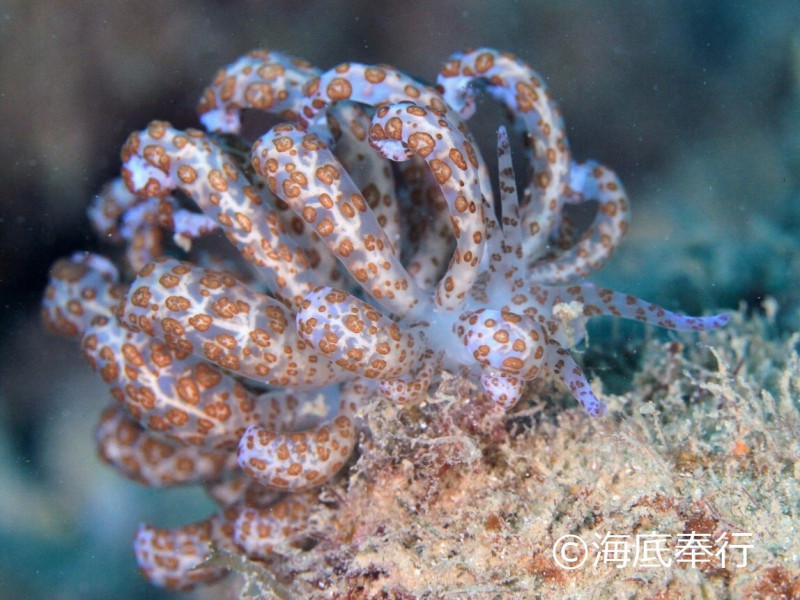
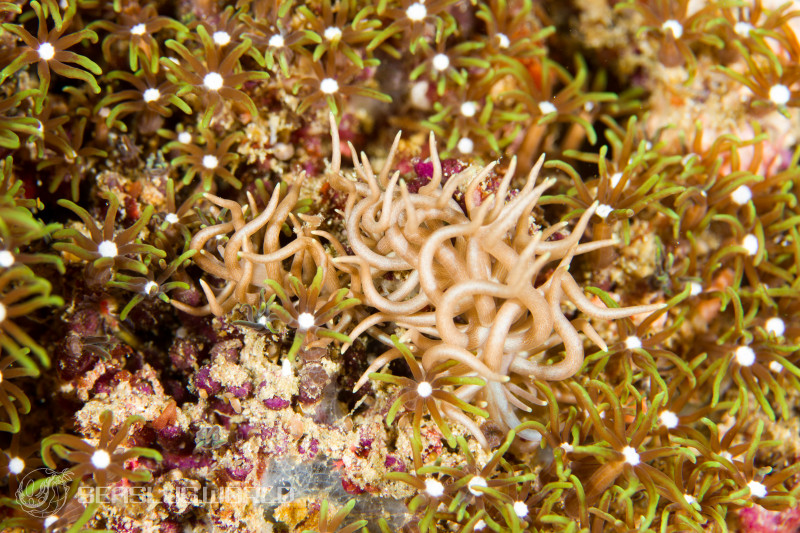
A pelagic aeolid — Glaucus atlanticus
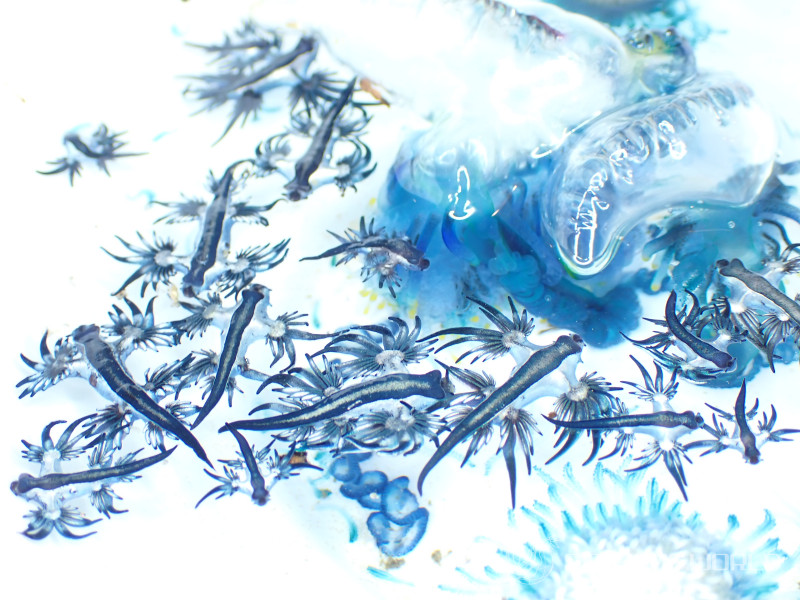
Still within the hydroid-feeding aeolids and still using kleptocnide, but with a wildly different lifestyle: Glaucus atlanticus is pelagic. It traps a bubble of air in its gut, floats at the sea surface, and drifts with the wind and current. It cannot actively swim, so meeting prey is largely a matter of chance.
Bieri (1966) collected 21 live Glaucus washed onto Shirahama beach (Seto Marine Biological Laboratory, central Japan) on 5 November 1965 after a north-northwest wind event. In the lab, he documented their feeding preferences directly:
- They actively attack Physalia (Portuguese man-o'-war)
- They show only mild interest in Velella and Porpita
- Starved individuals turn on each other (a 20 mm slug ate most of a 15 mm conspecific in 30 minutes)
A Physalia specialist that also stockpiles its prey's nematocysts for defence — the same kleptocnide mechanism as the reef aeolids above, deployed by an animal that drifts the open ocean.
One colouration detail worth correcting: Glaucus floats with its body inverted, so the side a diver sees from below is the dorsal side — silver-white, matching the sea surface from below — and the side a bird sees from above is the ventral side — bright blue, matching the open ocean from above. This is inverted countershading. Many popular accounts describe Glaucus as having "blue dorsal" colouration, which has the orientation backwards. Read its body in an upside-down posture and it all fits.
Sea slugs that eat other sea slugs — Gymnodoris
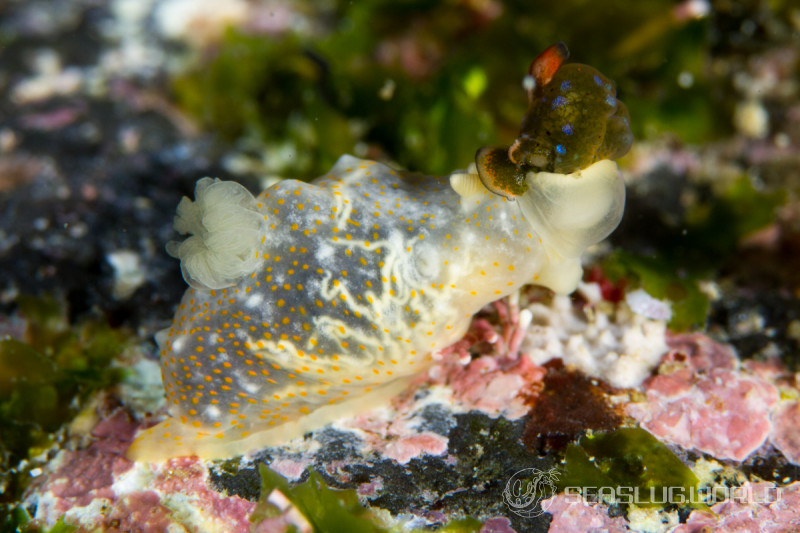
This is more common in the field than most people expect. But it is not a story of "Gymnodoris eats whatever sea slug is nearby." Each species in the genus has its own narrow prey preference — the same specialisation principle as in every other group above:
- Gymnodoris impudica (Japanese: kī-ibo-kinuhada) — preys on dorids such as Hypselodoris (aoumiushi)
- Gymnodoris alba (akaboshi) — preys on aeolids (Suborder Aeolidina), which sit in a different major clade of Nudibranchia from the dorid prey above
- Gymnodoris nigricolor (sumizome-kinuhada) — parasitises fish gills, a wildly different ecology that you rarely see in normal diving conditions
The Japanese vernacular for the genus, "kinuhada," literally means "thin-skinned" — and recently fed individuals are visibly distended, with their last meal partly visible through the body wall. As spectacular as "sea slug eats sea slug" looks, the internal specialisation is just as fine-grained here as in the rest of the radiation.
Egg-eaters — Favorinus and Calliopaea pusilla
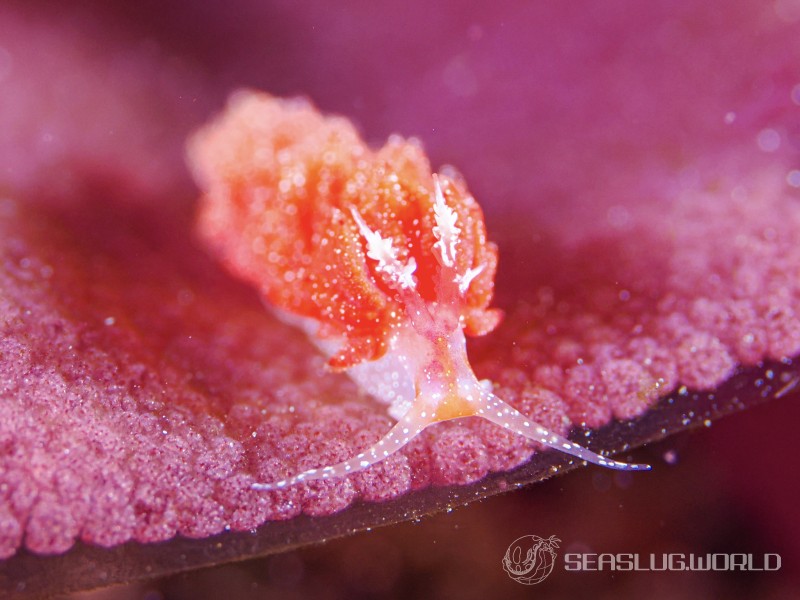
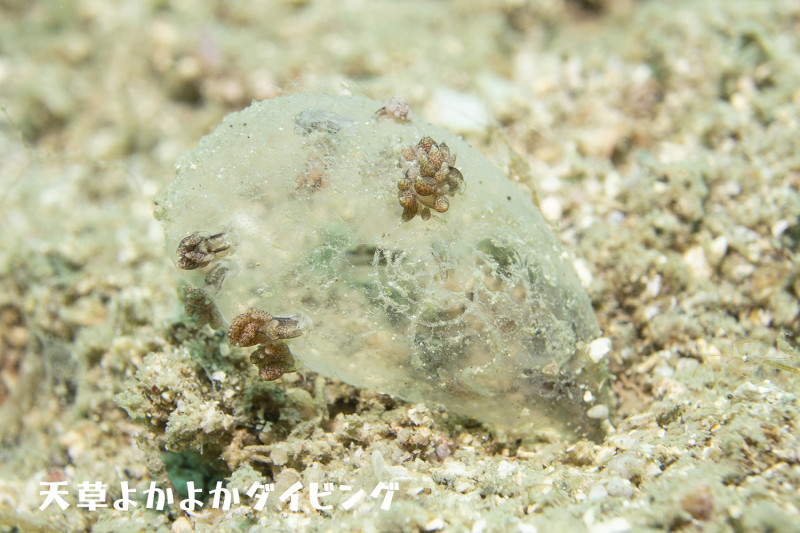
Sea slugs that feed on the egg masses of other marine invertebrates. Two Japanese examples:
- Genus Favorinus — aeolids that feed on the egg masses of other sea slugs. Favorinus japonicus (Baba, 1949) was already described with feeding notes; F. tsuruganus (Baba & Abe, 1964) and other congeners follow the same pattern. The reason you occasionally find small Favorinus on the large, flower-like egg ribbon of Hexabranchus (the Spanish dancer) is no coincidence — they are tracking their prey.
- Calliopaea pusilla (kotsubumo-umiushi, Baba, 1968) — a sacoglossan that eats eggs, which is doubly exceptional. A 1–2 mm sacoglossan with its type locality in Osaka Bay, central Japan; almost all sacoglossans feed on green algae (the kleptoplastic group below), yet C. pusilla preys on the egg masses of small cephalaspideans (Hamatani & Irie 1984). After collection records in 1957 and 1959, the species had not been reported again for decades and was listed as "Data Deficient" on the Osaka Prefecture Red List — until a 2017 rediscovery near the type locality, after roughly 60 years of silence (Kashio 2019, Umiushi-tsushin No.105).
Egg-eating has thus been independently acquired in two distant lineages — Aeolidina and Sacoglossa — a small but striking case of parallel evolution onto the same food resource.
Bryozoan / ascidian / polychaete feeders
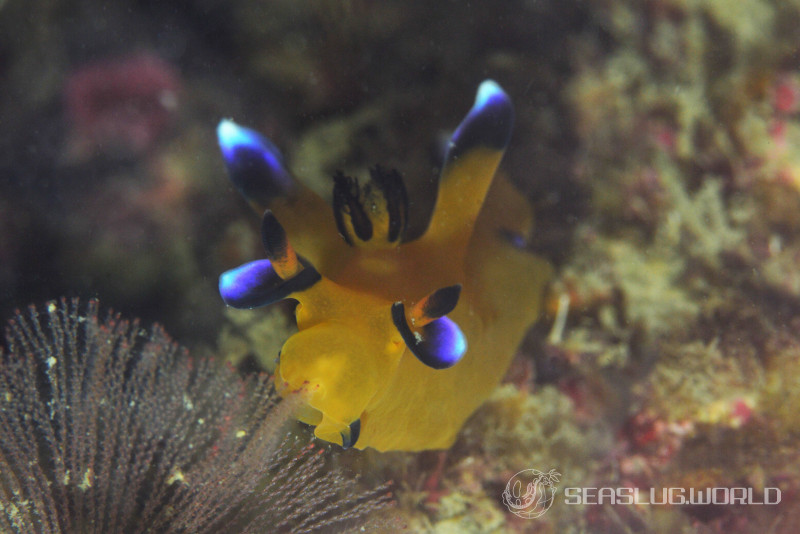
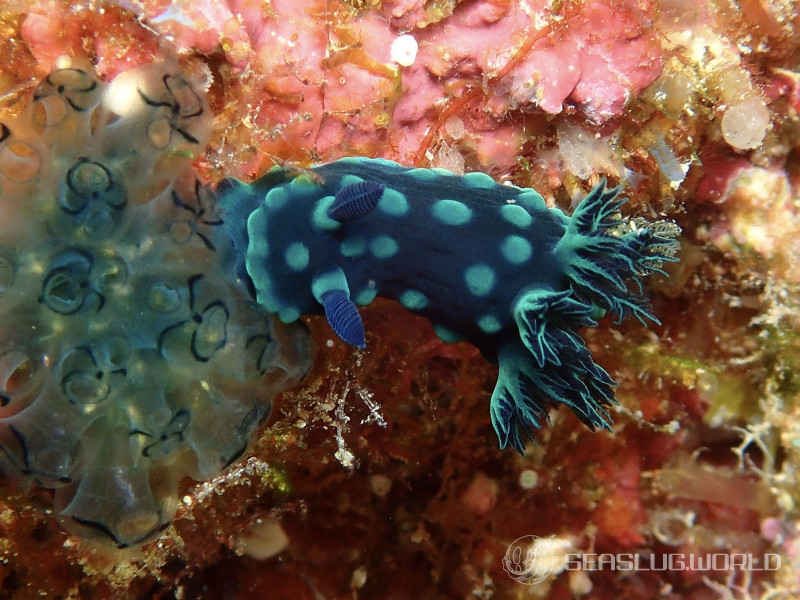
Bryozoan eaters are scattered across Goniodorididae and Polyceridae; ascidian eaters are mainly in the Subfamily Nembrothinae (Polyceridae) — Nembrotha and Tambja are the genera divers most often see; polychaete eaters are mostly the still-shelled Acteonoidea, an older lineage. From a diver's perspective, these are the small-to-medium species you find on "that brown encrusting thing that isn't coral and isn't sponge." Useful rule of thumb: small sea slug on bryozoan = it eats the bryozoan.
Exception 1: Sacoglossa — green-algae eaters that hoard chloroplasts
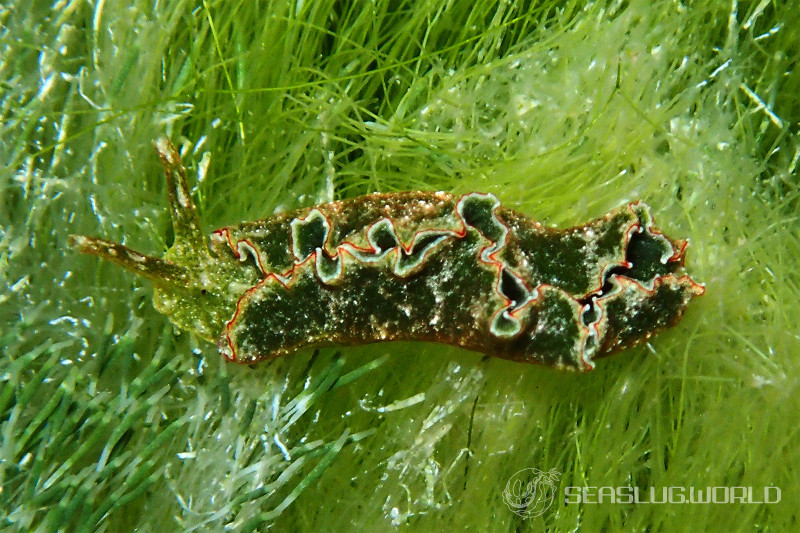
This is where it gets weird. The Sacoglossa feed by piercing green algal cells with a single tooth and sucking out the cytoplasm — but they don't digest the chloroplasts. Instead, the plastids are taken up into the slug's own digestive epithelium and kept functional for days to months, photosynthesising for the slug while they last. This is kleptoplasty.
Fan et al. (2014) reared Placida sp. YS001 (Yellow Sea, China) on the green alga Bryopsis and quantified short-term plastid retention. The retention is shorter than the popular "half plant" framing suggests, but it is real.
The famous case is Elysia chlorotica from the North Atlantic, which can apparently survive for months on photosynthesis alone. A high-profile claim that E. chlorotica had horizontally transferred algal genes into its own genome was later overturned, but the basic phenomenon — an animal kept alive by stolen plastids for that long — is still extraordinary.
Sacoglossans you actually see in Japan include:
- Placida babai / P. dendritica — on filamentous green algae (despite the Japanese name "midori-amamo-umiushi," they are not on seagrass)
- Elysia species — on the same coloured algae they feed on (visual crypsis)
- Plakobranchus species — on sand, looking like flat green sheets
- Costasiella species — on the green alga Avrainvillea, looking like little hairs growing out of the plant
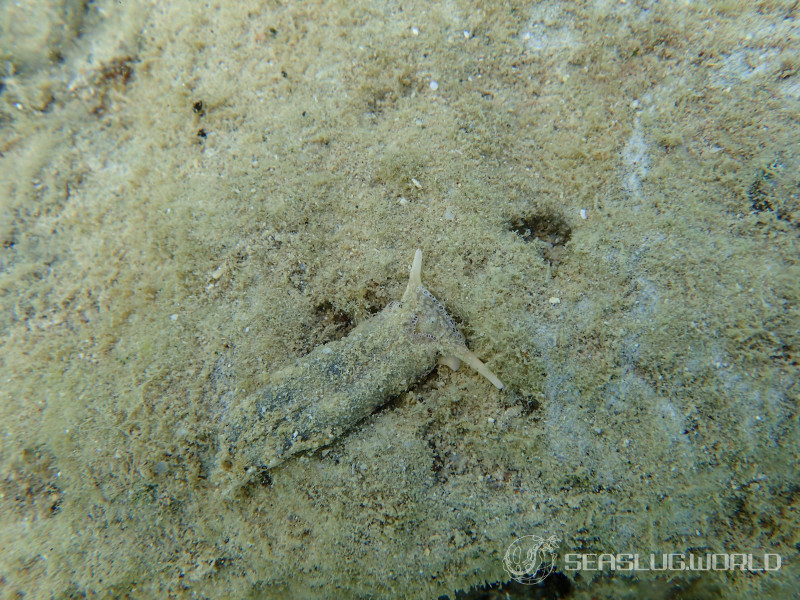
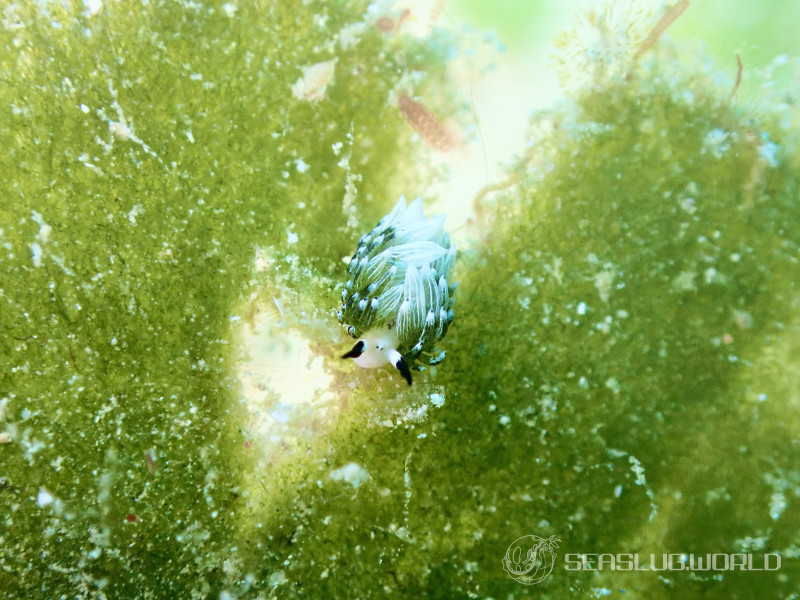
Baba (1986) provided a detailed anatomical study of Placida dendritica — a classic reference for sacoglossan internal morphology.
Exception 2: Aplysiida (sea hares) — the herbivore generalist
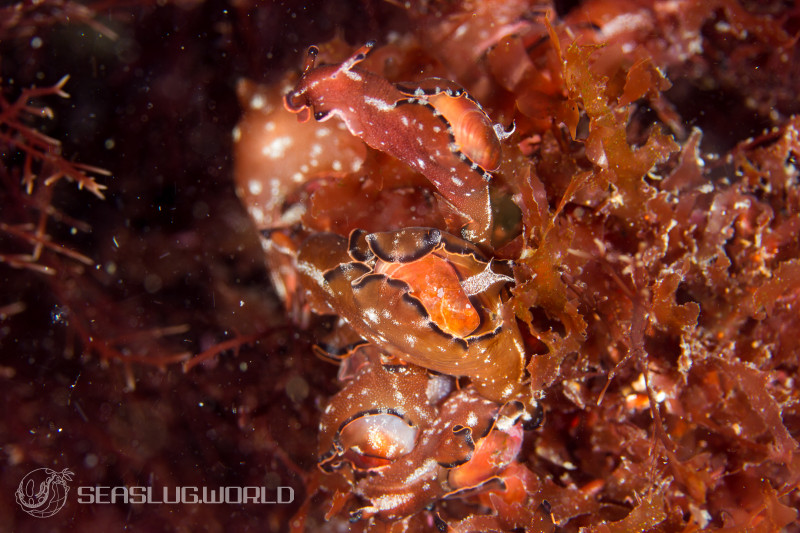
Aplysiida (sea hares) are included on this site as broad-sense sea slugs — see What is a Sea Slug? — Nine Orders to Twelve Lineages for the full scope discussion. On the feeding axis, though, they sit at the opposite extreme from the carnivorous groups discussed above. Wägele 2005 summarises it in one sentence:
"Anaspidea feed on red, brown and green algae."
In other words, Aplysiida as a group browse a wide range of seaweeds, but each individual species still has its own preferences — one will favour wakame-type browns, another sargassum, another sea lettuce. The species-level specialisation is in the same fine-grained range as the carnivorous sea slugs covered above; the difference is the direction of the food source (animal vs. plant) rather than the breadth of specialisation.
So the answer to "what's the difference between a nudibranch and a sea hare?" can be answered on the feeding axis too: carnivorous specialist vs. herbivorous specialist (with internal shell-vestige differences as the morphological half of the answer).
What you notice once you watch the substrate
If you read back through dive logs, the location memory and the prey memory blur together. Phyllidia on the dark sponge. Pteraeolidia on the hydroid sprig. Elysia on the green sheet. Plakobranchus on the sand patch. Gymnodoris in the same patch as the other dorids. Glaucus on a wind-driven stranding.
I started photography by looking at "the sea slug itself." After a few years, I caught myself looking just as much at what the sea slug was sitting on. That shift is, basically, what it feels like to internalise that these animals are dietary specialists.
Each species page on this site is slowly being updated to record the prey alongside the species. Knowing "this one eats that" before you go diving changes how you search.
References
- Wägele, H. & Klussmann-Kolb, A. (2005) "Opisthobranchia – more than just slimy slugs. Shell reduction and its implications on defence and foraging" Frontiers in Zoology 2:3. doi:10.1186/1742-9994-2-3 (Open Access)
- Bieri, R. (1966) "Feeding preferences and rates of the snail, Ianthina prolongata, the barnacle, Lepas anserifera, the nudibranchs, Glaucus atlanticus and Fiona pinnata" Publ. Seto Mar. Biol. Lab. 14(2):161-170. Kyoto Univ. KURENAI
- Fan, X. et al. (2014) "Short-term retention of kleptoplasty from a green alga (Bryopsis) in Placida sp. YS001" Biologia 69(5):635-643. doi:10.2478/s11756-014-0355-y
- Togawa, Y. et al. (2019) "Development of Cerata in Pteraeolidia semperi" Zoological Science 36(5):387-394. doi:10.2108/zs190057
- Togawa, Y. (2021) 「餌から武器を盗んで利用するミノウミウシの防御機構」 Umiushi-tsushin No.113:5-7
- Kashio, S. (2019) 「大阪湾の干潟域にすむウミウシ類: 希少種とその保全について」 Umiushi-tsushin No.105:2-4 — Osaka Bay intertidal sea slugs and their Red List status, including a 2017 Calliopaea pusilla rediscovery
- Hamatani, I. & Irie, S. (1984) — original 1957/1959 collection record + feeding notes for Calliopaea pusilla, as cited in Kashio 2019
- Greenwood, P.G. et al. (2004) "Adaptable defense: a nudibranch mucus inhibits nematocyst discharge and changes with prey type" Biological Bulletin 206:113-120
- Robilliard, G.A. & Baba, K. (1972) "Aldisa sanguinea cooperi subspec. nov. ... with notes on its feeding and spawning habits" Publ. Seto Mar. Biol. Lab. 19(6). Kyoto Univ. KURENAI
- Baba, K. (1986) "Anatomical information on Placida dendritica from Okino-Erabu Island, southern Kyushu, Japan" Boletim de Zoologia
Enjoyed this post? You can tip the author directly —
Tip this post