Hypselodoris whitei (A. Adams & Reeve, 1850)
Description
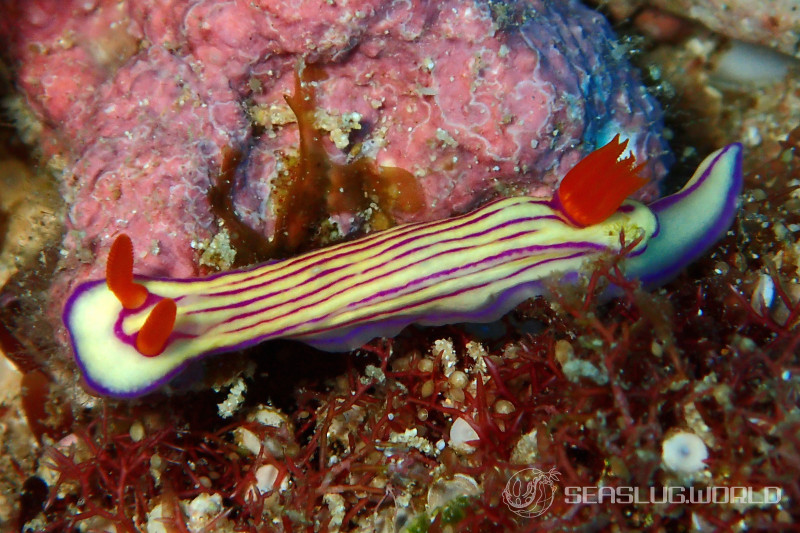
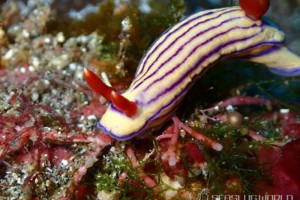
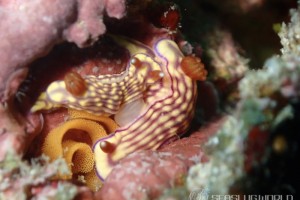
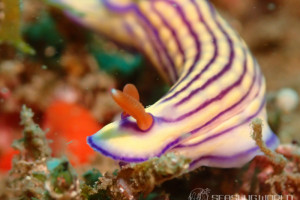
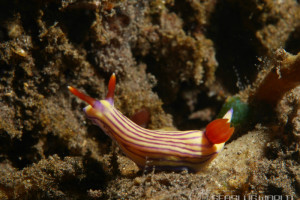
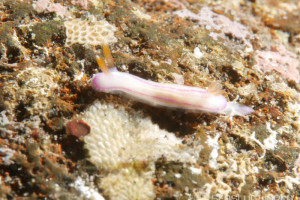
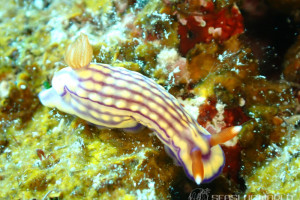
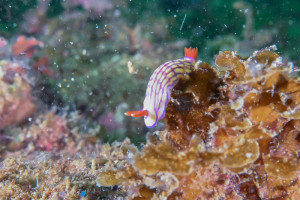
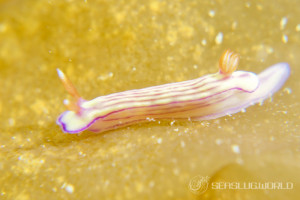
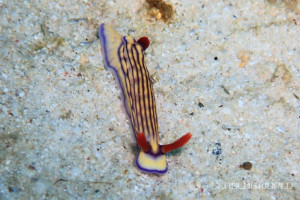
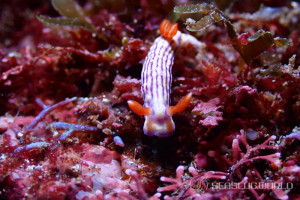
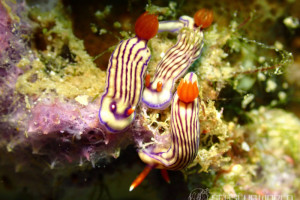
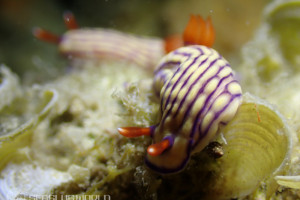
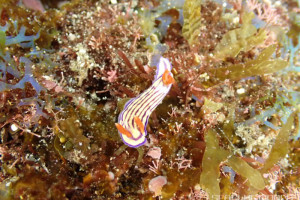
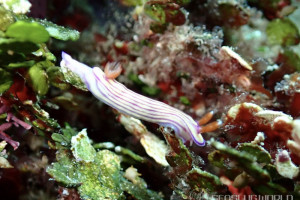
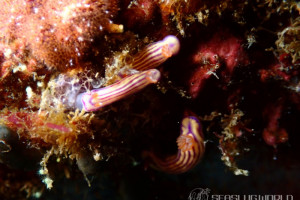
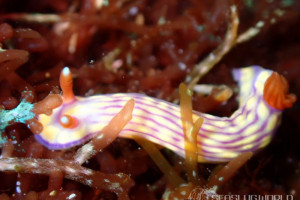
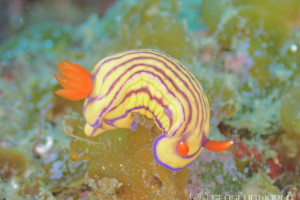
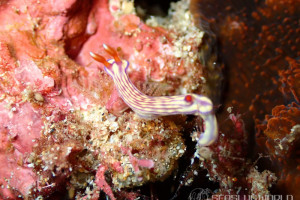
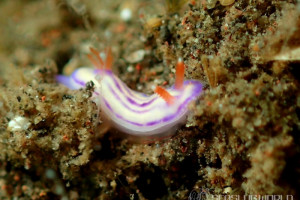
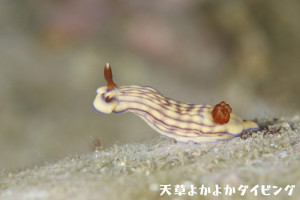
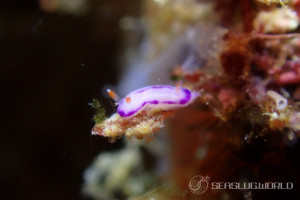
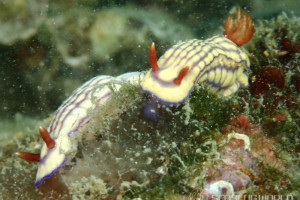
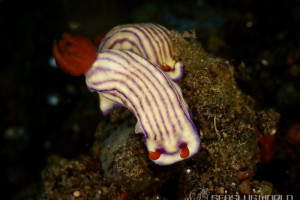
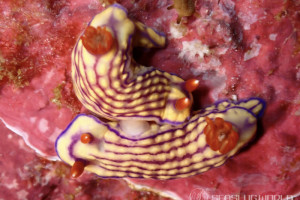
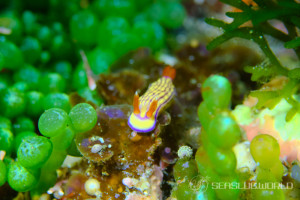
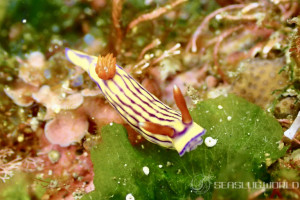
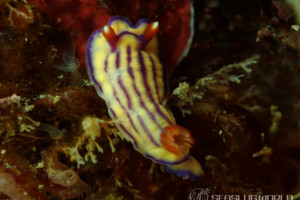
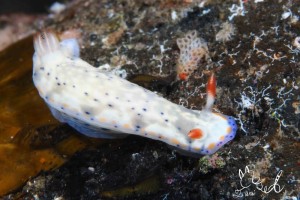
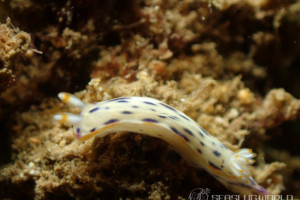
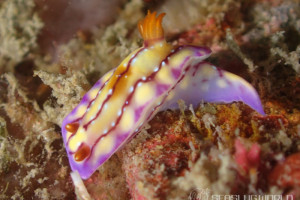
Body is whitish to pale cream, with five bright purple to reddish-purple longitudinal lines running along the dorsum. These lines tend to fuse anteriorly and posteriorly, forming closed loops that enclose the rhinophore and gill bases. Two additional purple lines run along each side of the body, and a fine purple line edges the mantle margin, foot brim, and gill opening. The rhinophores are orange to red-orange with white tips, and the gills are similarly orange with white inner surfaces or tips on each branchial leaf. Reaches about 30 mm in length.Distribution
Type locality is the Caramata Passage between Sumatra and Borneo. Widely distributed across the Indo-West Pacific, including Indonesia, the Philippines, Malaysia, Papua New Guinea, the Solomon Islands, New Caledonia, eastern Australia, and the Marshall Islands. In Japan, it occurs on rocky reefs from central Honshu southwards.Etymology
The specific epithet whitei honours Adam White (1817-1878), a British naturalist at the British Museum who specialised in crustaceans and insects and contributed to the study of specimens collected by H.M.S. Samarang. The describers, Arthur Adams and Lovell Reeve, dedicated the species to him in recognition of his taxonomic work.Remarks
Originally described as Goniodoris whitei A. Adams & Reeve, 1850 in the zoology report of the H.M.S. Samarang voyage, and later transferred to the genus Hypselodoris Stimpson, 1855. Chromodoris mouaci Risbec, 1930 and Hypselodoris centunculus Yonow, 1994 are now treated as synonyms. The Japanese vernacular name "Kuchinashi-iroumiushi" was proposed by a 1953 paper, who reported Japanese specimens as a colour variant of Glossodoris hilaris (Bergh, 1890). The species concept was clarified by a 1999 revision in their phylogenetic revision of the Indo-Pacific Hypselodoris clade. The superficially similar Indian Ocean species Hypselodoris maridadilus Rudman, 1977 differs in lacking white markings on rhinophores and gills.References
- Glossodoris hilaris (BERGH, 1890) Kuchinashi-iroumiushi (new name), Baba K. (1953). THREE NEW SPECIES AND TWO NEW RECORDS OF THE GENUS GLOSSODORIS FROM JAPAN. Publications of the Seto Marine Biological Laboratory. 3(2): 205-211. https://doi.org/10.5134/174468
- Hypselodoris whitei (Adams & Reeve, 1850), Gosliner T.M. & Johnson R.F. (1999). Phylogeny of Hypselodoris (Nudibranchia: Chromodorididae) with a review of the monophyletic clade of Indo-Pacific species, including descriptions of twelve new species. Zoological Journal of the Linnean Society. 125: 1-114. https://doi.org/10.1111/j.1096-3642.1999.tb00585.x
- クチナシイロウミウシ, 小野篤司. (1999). ウミウシガイドブック. TBSブリタニカ.
- ヒプセロドーリス・ホワイテイ, 殿塚孝昌. (2003). ウミウシガイドブック〈3〉. TBSブリタニカ.
- クチナシイロウミウシ, 小野篤司. (2004). 沖縄のウミウシ. ラトルズ.
- クチナシイロウミウシ, 中野理枝. (2004). 本州のウミウシ. ラトルズ.
- Hypselodoris whitei, Johnson R.F. & Gosliner T.M. (2012). Traditional taxonomic groupings mask evolutionary history: a molecular phylogeny and new classification of the chromodorid nudibranchs. PLoS ONE 7(4): e33479.
A Kindle field guide by the site author
Kimoto N. (2026). Sea Slugs of Japan & the Indo-Pacific, 2nd Edition.
Kindle Edition
View on Amazon PR (Amazon Associates)Seasonality
Shooting Locations
Loading shooting locations...
Photos of Hypselodoris whitei
Tag:






















Same Genus Nudibranchs

Similar Colors Nudibranchs

Academic Database
Sea slug observation data is available in international marine biodiversity databases.