Coryphellina delicata (Gosliner & Willan, 1991)
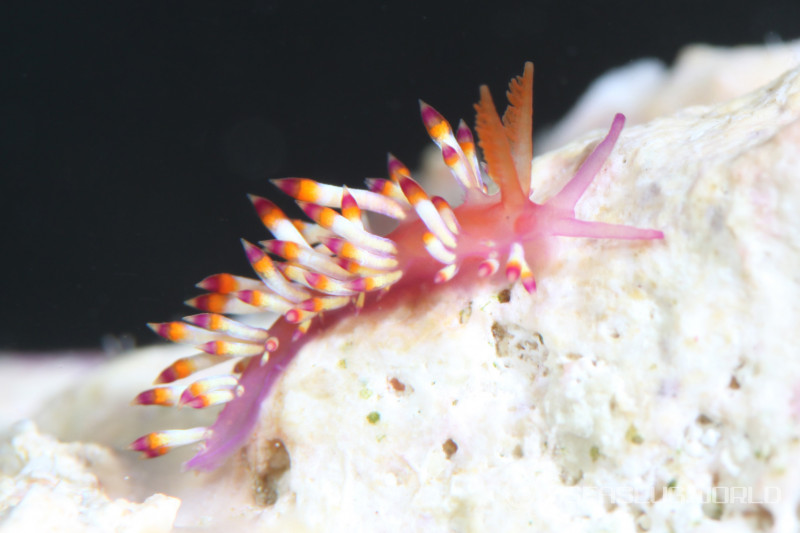
- Location
- Sunabe Water Treatment Plants, Okinawa Island (Chatan and Southern area), Okinawa, Japan
- Date
- 2012/03/04
- Length
- 13mm
- Depth
- 8.0m
- Water temperature
- 21.0℃
Description
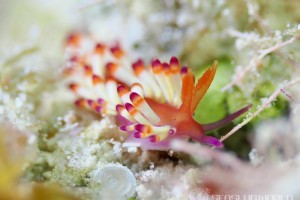
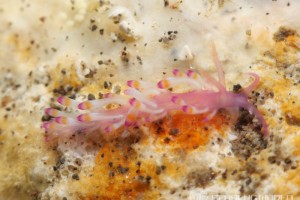
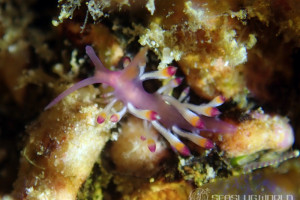
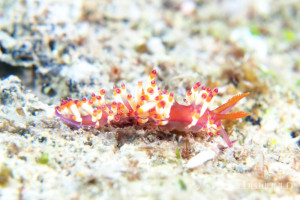
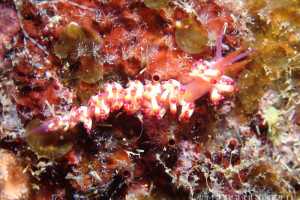
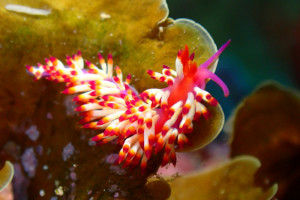
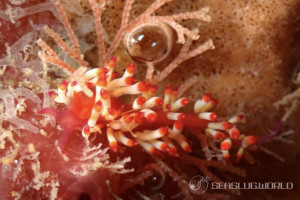
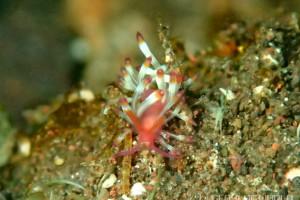
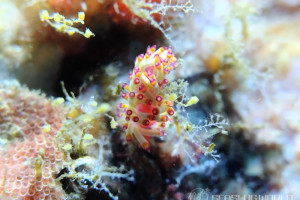
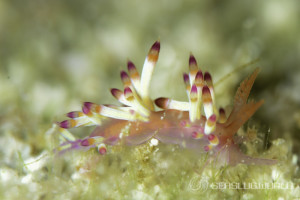
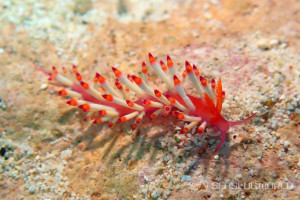
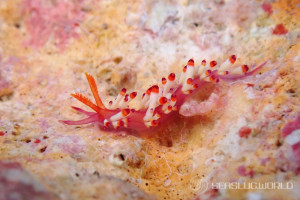
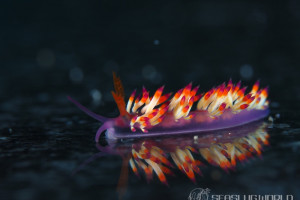
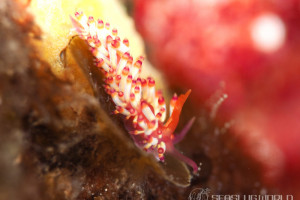
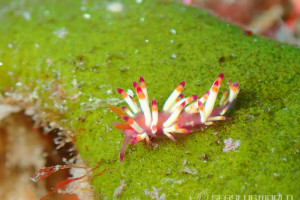
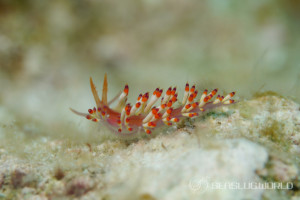
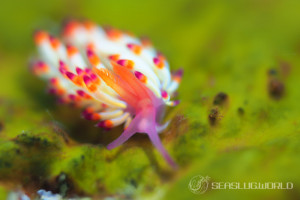
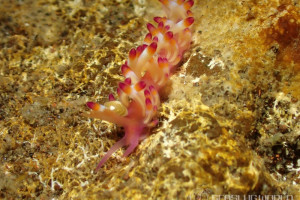
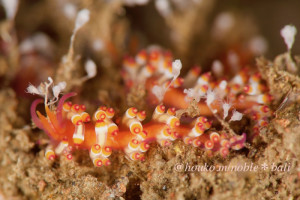
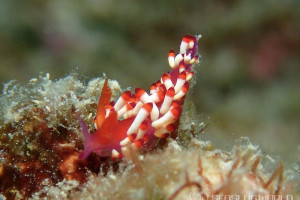
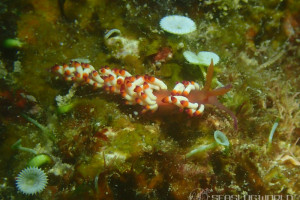
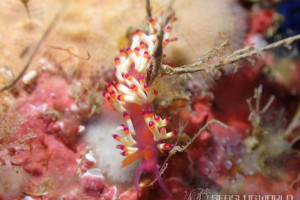
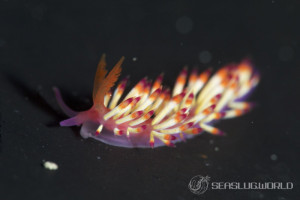
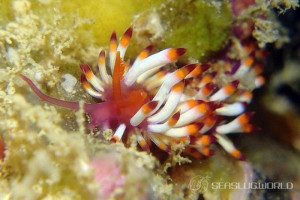
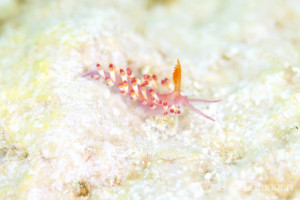
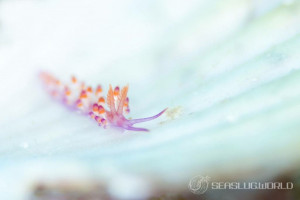
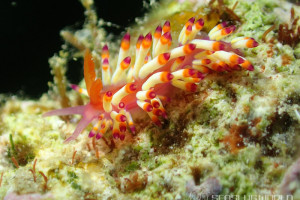
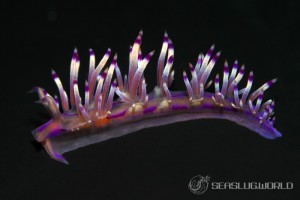
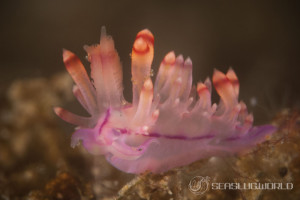
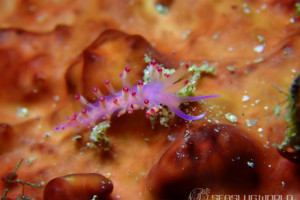
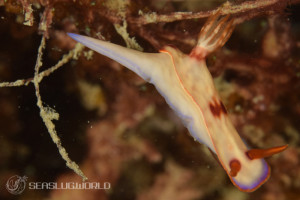
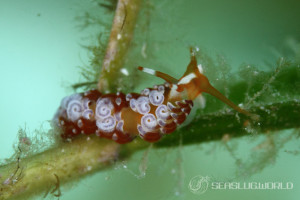
A flabellinid 15–20 mm in length. The general body color is deep reddish purple. Generally, the oral tentacles are a deeper purple than the rest of the body. The rhinophores are deep red throughout. The cerata are translucent white basally, with the opaque white digestive gland giving the cerata an overall white appearance. Near the middle of each ceras, an opaque white transverse band is present on its surface. More distally, the ceras is again translucent and a golden-yellow-orange enlarged portion of the digestive gland is visible. A subapical transverse ring of translucent purple is present just below the translucent white apex.The body is narrow and delicate in appearance, as reflected in the specific name. The notal brim is slightly expanded at the base of the cerata, but is otherwise reduced. The oral tentacles are slender and elongate, terminating at an acute apex. The rhinophores are elongate and slender with approximately 30 well-separated papillae on their posterior surface. The rhinophores terminate at an acute apex. The tentacular foot corners are elongate and acutely pointed.
The numerous cerata are slender and cylindrical throughout their length. The cerata are arranged in distinct, well-separated clusters. The precardiac cluster contains 3 or 4 distinct rows with 1–6 cerata per row. The postcardiac clusters are arranged in 5–8 horseshoe-shaped arches. The anteriormost arch contains 6–10 cerata. More posterior arches contain fewer cerata. The posteriormost arch contains 1–3 cerata. The gonopore is situated ventral to the posterior 2 rows of the precardiac ceratal cluster. The pleuroproctic anus is situated in the interhepatic space, ventral to the edge of the notum. The nephroproct is immediately anterodorsal to the anus.
The buccal mass is small relative to the rest of the body. The narrow ducts of the paired oral glands emanate from the anterior portion of the buccal mass. The jaws are broad and ovoid. The masticatory border bears 5 or 6 rows of small denticles. The outermost row bears the longest denticles. The radular formula is 31 × 1·1·1· in two specimens examined. The rachidian teeth are broad with short lateral limbs. There are 6–9 elongate, acute denticles on either side of the elongate central cusp. The central cusp is depressed below the level of the adjacent denticles. The lateral teeth are triangular with a relatively broad base. The primary cusp is narrow and elongate. There are 15–18 minute denticles along most of the inner margin of the laterals.
The reproductive system is most similar to Coryphellina rubrolineata. The narrow preampullary duct curves and widens into the saccate ampulla. The ampulla curves, narrows, and divides into the oviduct and vas deferens. The short oviduct joins with the two receptacula seminis (bilobed), which are approximately equal in size. The oviduct continues for a short distance and enters the albumen gland. The albumen and membrane glands are adjacent to each other and are much smaller than the voluminous mucous gland. From the entrance of the oviduct into the female gland mass, the vaginal duct continues distally towards its own aperture adjacent to the penis. The vagina gives rise to a small bursa copulatrix immediately prior to exiting at the female pore. The vas deferens is short and straight and appears to be prostatic nearest the ampulla. It is uniform in diameter for most of its length and is contiguous with the simple, unarmed penial papilla.
Distribution
Type locality: the Quarry, approximately 1 km S of Cape Croiselles, Madang, Papua New Guinea, at 30.5 m maximum depth. Known from Papua New Guinea and Natal, South Africa. The specimen figured in a 1987 paper as Coryphellina sp. is referable to this species.Etymology
The specific epithet delicata is Latin for "delicate, graceful" and refers to the elongate, graceful body form of this species.Remarks
Originally described as Flabellina delicata Gosliner & Willan, 1991. The cladistic analysis of a 2017 revision transferred the species to Coryphellina; the currently valid name is Coryphellina delicata.The unique color pattern distinguishes C. delicata from other members of the genus with papillate rhinophores. Its notal brim is more reduced than in C. rubrolineata, as in F. marcusorum and C. exoptata. The papillae on the rhinophores are fewer in number and sparser in arrangement than in the other species that possess papillae. The postcardiac ceratal clusters are arranged in horseshoe-shaped arches as in C. rubrolineata and F. marcusorum rather than in linear rows as in C. exoptata. However, C. delicata has more cerata per cluster than do the other species.
The rachidian radular teeth of C. delicata are broader relative to their length than in C. rubrolineata, F. marcusorum, or C. exoptata. Only C. exoptata and C. delicata have numerous denticles on the cutting edge of the lateral teeth.
The reproductive system of C. delicata is most similar to C. rubrolineata. Both species have a reduced bursa copulatrix; however, the vas deferens is shorter and straighter in C. delicata than in C. rubrolineata.
References
- Coryphellina sp., Gosliner T.M. (1987). Nudibranchs of Southern Africa: A Guide to Opisthobranch Molluscs of Southern Africa. Sea Challengers, Monterey, CA. 136 pp.
- Flabellina delicata Gosliner & Willan, sp. nov., Gosliner, T. M.; Willan, R. C. (1991). Review of the Flabellinidae (Nudibranchia: Aeolidacea) from the tropical Indo-Pacific, with the descriptions of five new species. The Veliger. 34(2): 97-133.
- ツマベニミノウミウシ, 小野篤司. (2004). 沖縄のウミウシ. ラトルズ.
- Flabellina delicata, Terrence Gosliner, Ángel Valdés and David Behrens. (2015). Nudibranch and Sea Slug Identification Indo-Pacific. New World Pubns Inc.
- Coryphellina (?) delicata (Gosliner & Willan, 1991), comb. n., Korshunova T., Martynov A., Bakken T., Evertsen J., Fletcher K., Mudianta I.W., Saito H., Lundin K., Schrödl M. & Picton B. (2017). Polyphyly of the traditional family Flabellinidae affects a major group of Nudibranchia: aeolidacean taxonomic reassessment with descriptions of several new families, genera, and species (Mollusca, Gastropoda). ZooKeys. 717: 1-139. https://doi.org/10.3897/zookeys.717.21885
Featured in this book

Terrence Gosliner, Ángel Valdés and David Behrens. (2018). Nudibranch and Sea Slug Identification Indo-Pacific 2nd Edition. New World Pubns Inc.
New World Publications
This species, Coryphellina delicata, is included in the book.
View on Amazon PR (Amazon Associates)Seasonality
Shooting Locations
Loading shooting locations...
Photos of Coryphellina delicata
Tag:






















Same Genus Nudibranchs


Similar Colors Nudibranchs

Academic Database
Sea slug observation data is available in international marine biodiversity databases.